
DP-100 · Question #64
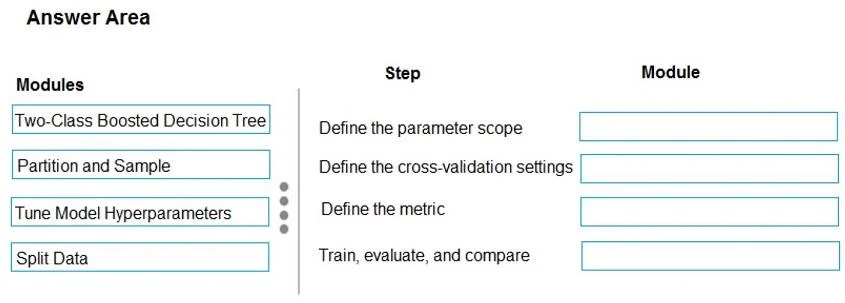
Drag and Drop Question You have a model with a large difference between the training and validation error values. You must create a new model and perform cross-validation. You need to identify a…
This question tests the ability to correctly map Azure Machine Learning Studio modules to steps involved in cross-validation and hyperparameter tuning to find an optimal parameter set for a new model.
Question
Exhibit
Explanation
This question tests the ability to correctly map Azure Machine Learning Studio modules to steps involved in cross-validation and hyperparameter tuning to find an optimal parameter set for a new model.
Approach. The correct mapping, as shown in the provided solution image, is as follows:
- Define the parameter scope -> Split Data: While 'parameter scope' typically refers to the range of hyperparameters, in the context of preparing for cross-validation and tuning, 'Split Data' can be used to initially partition the dataset. This module helps define the initial data scope upon which the subsequent tuning and evaluation steps will operate, for example, separating a validation set or a general dataset for further processing.
- Define the cross-validation settings -> Partition and Sample: The 'Partition and Sample' module in Azure Machine Learning Studio is specifically designed for various data partitioning tasks, including creating 'N' folds for cross-validation. This directly corresponds to defining how the data will be split and organized for a cross-validation experiment.
- Define the metric -> Two-Class Boosted Decision Tree: This step requires a nuanced interpretation. A 'Two-Class Boosted Decision Tree' is a model algorithm, not a metric itself. However, to 'define the metric' for evaluation, you must first specify the type of model being used, as metrics are specific to model types (e.g., AUC for binary classification models like a two-class decision tree). The 'Tune Model Hyperparameters' module takes an untrained learner (such as this decision tree) as input, and subsequently allows you to choose the primary metric for optimization.
- Train, evaluate, and compare -> Tune Model Hyperparameters: The 'Tune Model Hyperparameters' module is precisely engineered to automate the entire process of training multiple models with different hyperparameter combinations, evaluating their performance (often using cross-validation as configured within the module), and comparing the results to identify the best-performing parameter set. This module perfectly encapsulates the 'Train, evaluate, and compare' step for finding optimal parameters.
Common mistakes.
- common_mistake. Common mistakes include confusing a model algorithm ('Two-Class Boosted Decision Tree') with an evaluation metric (e.g., accuracy, AUC). Assigning 'Two-Class Boosted Decision Tree' directly as a 'metric' is technically incorrect, but as explained, it's a prerequisite to selecting appropriate metrics. Another mistake would be to use 'Split Data' where 'Partition and Sample' is more appropriate for generating cross-validation folds, or vice-versa, indicating a misunderstanding of their specific roles. Finally, misplacing 'Tune Model Hyperparameters' to any step other than the final training, evaluation, and comparison phase would be incorrect, as it orchestrates this entire optimization process.
Concept tested. The core concept tested is the understanding of the machine learning workflow in Azure Machine Learning Studio, specifically hyperparameter tuning, cross-validation techniques, and the correct application and function of key modules such as 'Split Data', 'Partition and Sample', 'Tune Model Hyperparameters', and model algorithms (e.g., 'Two-Class Boosted Decision Tree') within that workflow.
Topics
Community Discussion
No community discussion yet for this question.