
DP-100 · Question #557
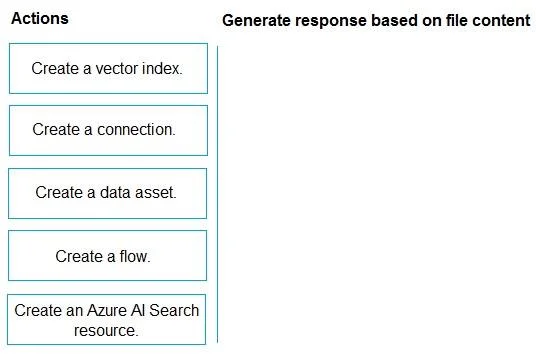
Drag and Drop Question You have an Azure AI Foundry project with a connected Azure OpenAI Service model. You have a set of text files stored locally on your computer. You must set up a flow that…
The correct answer is Create an Azure AI Search resource.; Create a connection.; Create a vector index.; Create a flow. The correct sequence for setting up a Retrieval Augmented Generation (RAG) flow in Azure AI Foundry using local files involves establishing an AI Search resource, creating a connection, building a vector index, and then orchestrating these components within a flow.
Question
Exhibit
Answer Area
Drag items
Correct arrangement
- Create an Azure AI Search resource.
- Create a connection.
- Create a vector index.
- Create a flow.
Explanation
The correct sequence for setting up a Retrieval Augmented Generation (RAG) flow in Azure AI Foundry using local files involves establishing an AI Search resource, creating a connection, building a vector index, and then orchestrating these components within a flow.
Approach. The goal is to implement a solution to generate responses based on local file content using an existing Azure OpenAI Service model in Azure AI Foundry, which is a classic Retrieval Augmented Generation (RAG) scenario. The correct logical sequence of actions to achieve this is:
- Create an Azure AI Search resource: For RAG, you need a service to store and search the vector embeddings of your document content. Azure AI Search (formerly Azure Cognitive Search) is the designated service for this purpose in Azure. It must be created first to provide the underlying infrastructure.
- Create a connection: After setting up the Azure AI Search resource, you need to establish a connection from your Azure AI Foundry project to this new resource. This connection allows the project to interact with and utilize the search service.
- Create a vector index: With the search resource and its connection ready, the next step is to create a vector index. This process involves ingesting the local text files (which can often be done directly as part of the index creation process, making a separate 'Create a data asset' step redundant in this context), chunking the data, generating vector embeddings using an embedding model (often provided by Azure OpenAI or another service), and storing these embeddings in the Azure AI Search resource. This step transforms your raw local files into a searchable knowledge base.
- Create a flow: Finally, to orchestrate the RAG solution, you create a flow in Azure AI Foundry. This flow will typically integrate the vector index (for retrieving relevant information from your local files) and the pre-configured Azure OpenAI Service model (for generating coherent responses based on the retrieved information and the user's query).
Common mistakes.
- common_mistake. A common mistake is an incorrect ordering of actions due to misunderstanding dependencies. For example, trying to create a vector index before an Azure AI Search resource exists or without a connection to it would fail. Another common error is including 'Create a data asset' as a distinct step. While a data asset is conceptually part of bringing local data into Azure AI Foundry, in the context of creating a vector index, the data ingestion from local files is often integrated into the 'Create a vector index' workflow itself, making 'Create a data asset' an optional or implicit step, especially when only four actions are required. Omitting core components like 'Create an Azure AI Search resource' or 'Create a vector index' would fundamentally prevent the RAG pattern from being implemented correctly.
Concept tested. The core technical concept being tested is the implementation of Retrieval Augmented Generation (RAG) patterns within Azure AI Foundry. This includes understanding the sequential steps and dependencies involved in preparing external data (local files) for use with large language models, specifically leveraging Azure AI Search for vector indexing and Azure OpenAI Service for generation.
Topics
Community Discussion
No community discussion yet for this question.