
DP-100 · Question #524
Drag and Drop Question You manage an Azure Al Foundry project. You fine-tune the base model. During evaluation, you observe that the model is overfitting and its responses are highly varying. You…
The correct answer is learning_rate_multiplier; batch_size. To improve a fine-tuned model that is overfitting and exhibiting high variance, adjust the learning_rate_multiplier to reduce overfitting and the batch_size to reduce variance.
Question
Exhibit
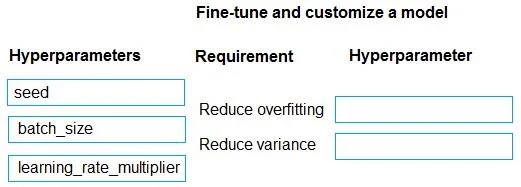
Answer Area
Drag items
Correct arrangement
- learning_rate_multiplier
- batch_size
Explanation
To improve a fine-tuned model that is overfitting and exhibiting high variance, adjust the learning_rate_multiplier to reduce overfitting and the batch_size to reduce variance.
Approach. To answer this question, you need to drag the 'learning_rate_multiplier' hyperparameter to the 'Reduce overfitting' requirement box and the 'batch_size' hyperparameter to the 'Reduce variance' requirement box.
-
Reduce overfitting: Overfitting occurs when a model learns the training data too well, including noise, leading to poor generalization. A lower
learning_rate_multiplier(resulting in a smaller learning rate) means smaller updates to the model's weights during training. This can prevent the model from rapidly adjusting to noise in the training data and making drastic changes that lead to over-specialization, thereby helping to mitigate overfitting and improve generalization. -
Reduce variance: High variance in model responses suggests instability and sensitivity to small fluctuations in the input data or training process. A larger
batch_sizeduring training leads to more stable and less noisy gradient estimates. This stability helps the model converge more smoothly and less erratically, making its predictions less sensitive to individual data points and thus reducing the variance in its responses.
Common mistakes.
- common_mistake. Dragging 'seed' to either requirement is incorrect because
seedis primarily used for reproducibility of experiments, ensuring that random processes (like weight initialization or data shuffling) yield the same results across multiple runs. It does not directly impact or reduce overfitting or variance in the model's performance. Similarly, swappinglearning_rate_multiplierandbatch_sizewould be incorrect, asbatch_sizeis more directly related to the stability of gradient estimates and reducing output variance, whilelearning_rate_multiplierinfluences the step size of weight updates, which is crucial for preventing overfitting.
Concept tested. Understanding and applying hyperparameters in machine learning model training, specifically for addressing overfitting and high variance in the context of fine-tuning large language models or similar deep learning models.
Topics
Community Discussion
No community discussion yet for this question.