
DP-100 · Question #510
Drag and Drop Question You have the following environment: - a Microsoft Entra ID service - a GitHub repository named Repo1 that stores the source code for training a model - an Azure Machine…
The correct answer is In Microsoft Entra ID, create a service principal.; In Repo1, create a secret.; In Repo1, create a GitHub workflow. To automate an Azure Machine Learning job trigger from GitHub, the correct sequence involves establishing secure programmatic access from GitHub to Azure, then defining the automation logic in a GitHub workflow.
Question
Exhibit
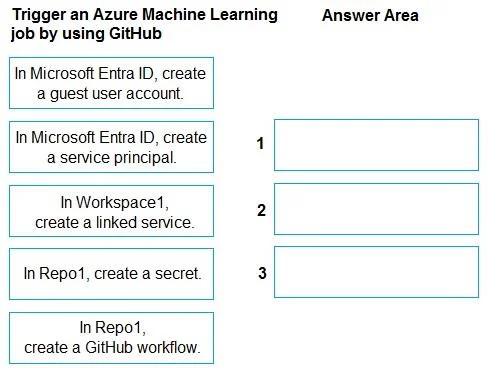
Answer Area
Drag items
Correct arrangement
- In Microsoft Entra ID, create a service principal.
- In Repo1, create a secret.
- In Repo1, create a GitHub workflow.
Explanation
To automate an Azure Machine Learning job trigger from GitHub, the correct sequence involves establishing secure programmatic access from GitHub to Azure, then defining the automation logic in a GitHub workflow.
Approach. The correct interaction involves dragging the following actions to the answer area in sequential order:
- 'In Microsoft Entra ID, create a service principal.' - This is the first step because GitHub Actions require an identity with appropriate permissions to interact with Azure resources, such as an Azure Machine Learning workspace. A service principal provides this non-human identity for secure programmatic access.
- 'In Repo1, create a secret.' - Once a service principal is created, its credentials (e.g., client ID, client secret) must be stored securely within the GitHub repository. GitHub Secrets are the standard mechanism for storing sensitive information that GitHub Workflows can access at runtime without exposing them in the workflow definition.
- 'In Repo1, create a GitHub workflow.' - The final step is to define the automation logic. A GitHub workflow, typically a YAML file, specifies the triggers (e.g., code push), jobs, and steps (e.g., using the service principal credentials from secrets to authenticate to Azure and then run Azure CLI commands to trigger an Azure Machine Learning job). This workflow orchestrates the entire process.
Common mistakes.
- common_mistake. 1. 'In Microsoft Entra ID, create a guest user account.' - This is incorrect because guest user accounts are designed for human users to access resources, not for automated, programmatic access from a CI/CD pipeline like GitHub Actions. Service principals are specifically for this purpose.
- 'In Workspace1, create a linked service.' - While Azure Machine Learning workspaces can integrate with various services, 'creating a linked service' is not the direct action needed to configure GitHub Actions to trigger an AML job. Linked services are more common in data integration services like Azure Data Factory or for connecting to data sources within AML itself. The scenario requires establishing GitHub's ability to call Azure AML, which is handled by service principals and workflow definitions, not a linked service from within the AML workspace to GitHub for triggering purposes.
Concept tested. The core concept being tested is the implementation of Continuous Integration/Continuous Deployment (CI/CD) pipelines using GitHub Actions to automate machine learning workflows in Azure Machine Learning. This includes secure access management using Microsoft Entra ID service principals and GitHub Secrets, and the orchestration of tasks via GitHub Workflows.
Topics
Community Discussion
No community discussion yet for this question.