
DP-100 · Question #274
Drag and Drop Question You create a multi-class image classification deep learning model. The model must be retrained monthly with the new image data fetched from a public web portal. You create an…
The correct answer is PipelineJob; RecurrenceTrigger; JobSchedule. The question requires identifying the correct sequence of Azure Machine Learning Python SDK v2 classes to instantiate for scheduling a pipeline monthly using frequency and interval properties.
Question
Exhibit
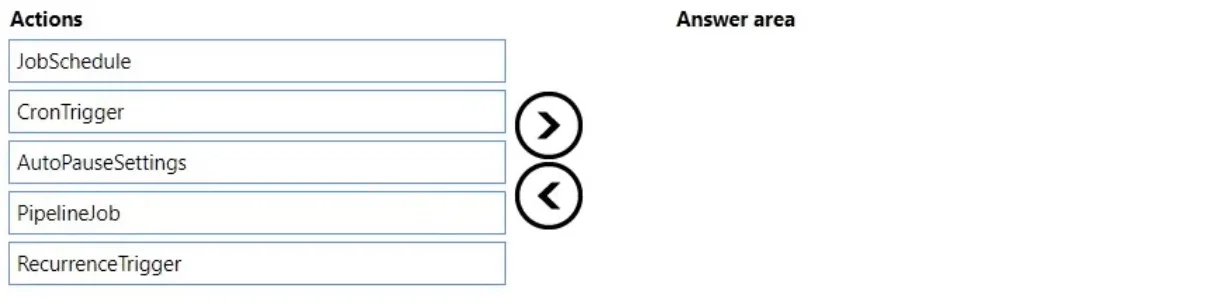
Answer Area
Drag items
Correct arrangement
- PipelineJob
- RecurrenceTrigger
- JobSchedule
Explanation
The question requires identifying the correct sequence of Azure Machine Learning Python SDK v2 classes to instantiate for scheduling a pipeline monthly using frequency and interval properties.
Approach. The correct interaction is to drag 'PipelineJob', then 'RecurrenceTrigger', and finally 'JobSchedule' to the 'Answer area' in that exact sequence.
- PipelineJob: The problem states 'configure the schedule for the pipeline'. In Azure ML Python SDK v2, a pipeline is represented by a
PipelineJob. While you might already have a PipelineJob object, to configure a schedule for it, you need to refer to this job. In a typical scheduling script, you'd first define or load yourPipelineJobdefinition. - RecurrenceTrigger: The requirement specifies defining the schedule 'by using the frequency and interval properties, with frequency set to "month" and interval set to "1"'. This directly points to a recurrence-based schedule, which is handled by the
RecurrenceTriggerclass. This trigger type allows defining schedules based on a simple frequency (e.g., month, day, hour) and interval. - JobSchedule: The
JobScheduleclass is used to create and manage the actual schedule in Azure Machine Learning. It combines a specific job (like aPipelineJob) with a trigger (like aRecurrenceTrigger) to define when and how that job should run repeatedly. Therefore, it's the final class instantiated to bind the job and its trigger into a persistent schedule.
Common mistakes.
- common_mistake. Using 'CronTrigger' instead of 'RecurrenceTrigger' is a common mistake. 'CronTrigger' is used when the schedule needs to be defined using a cron expression (e.g., '0 0 1 * *' for the first day of every month), which offers more complex scheduling patterns than simple frequency and interval. The question explicitly mentions 'frequency' and 'interval', making 'RecurrenceTrigger' the correct choice. 'AutoPauseSettings' is incorrect because it is used for managing the auto-pause behavior of compute instances, not for scheduling jobs. An incorrect order would also lead to a wrong answer, as the logical flow is to first identify the job, then define how it should be triggered, and finally combine them into a schedule object.
Concept tested. Azure Machine Learning Pipeline Scheduling using Python SDK v2, specifically understanding the roles of PipelineJob, RecurrenceTrigger, and JobSchedule classes for creating recurrence-based schedules.
Topics
Community Discussion
No community discussion yet for this question.