
DP-100 · Question #23
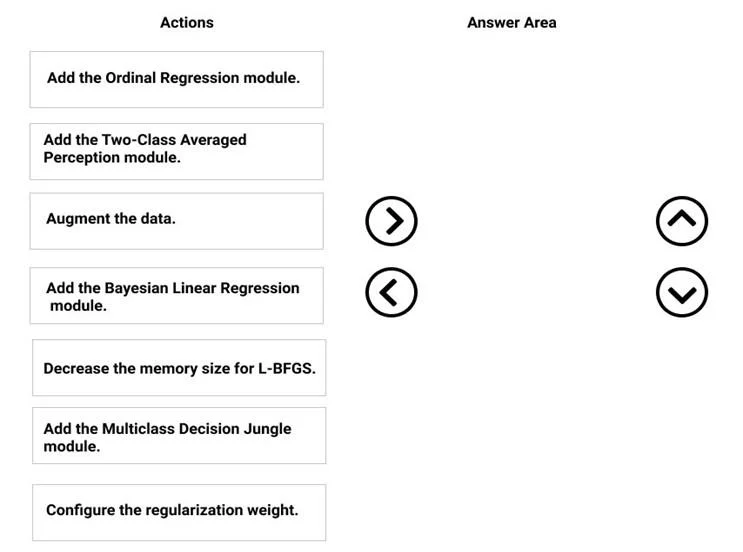
Drag and Drop Question You need to correct the model fit issue. Which three actions should you perform in sequence? To answer, move the appropriate actions from the list of actions to the answer…
The correct answer is Augment the data.; Add the Bayesian Linear Regression module.; Configure the regularization weight. To correct a model fit issue, especially overfitting, the sequence of actions involves data enrichment, choosing a robust model type, and fine-tuning regularization parameters.
Question
Exhibit
Answer Area
Drag items
Correct arrangement
- Augment the data.
- Add the Bayesian Linear Regression module.
- Configure the regularization weight.
Explanation
To correct a model fit issue, especially overfitting, the sequence of actions involves data enrichment, choosing a robust model type, and fine-tuning regularization parameters.
Approach. The question asks for three actions in sequence to correct a 'model fit issue.' This typically refers to problems like overfitting (model performs well on training data but poorly on unseen data) or underfitting (model performs poorly on both). Given the options, the most comprehensive approach to address such issues, especially overfitting, is:
- Augment the data: Overfitting often occurs due to insufficient or unrepresentative training data. Data augmentation involves creating modified versions of existing data to increase the size and diversity of the training set. This helps the model learn more robust features, generalize better to unseen data, and reduces its tendency to memorize training examples. This is a foundational step related to data preparation.
- Add the Bayesian Linear Regression module: If the current model struggles with fit, especially overfitting, switching to a more robust model can be beneficial. Bayesian Linear Regression incorporates prior distributions over model parameters, which inherently provides a form of regularization. This probabilistic approach can offer more stable and generalized predictions, especially when dealing with limited data or noisy datasets, making it less prone to overfitting compared to standard frequentist approaches.
- Configure the regularization weight: Regularization (e.g., L1 or L2) is a direct and powerful technique to prevent overfitting. It adds a penalty to the loss function for large model coefficients, thereby discouraging overly complex models. Even Bayesian models can have hyperparameters for their priors that act as regularization weights, or explicit regularization might be applied. Configuring this weight allows for fine-tuning the balance between model complexity and fitting the training data, directly controlling the model's capacity to overfit.
Common mistakes.
- common_mistake. Common mistakes include choosing actions that are not directly related to correcting model fit or selecting them in an illogical order. For example:
- Adding other specific model modules (e.g., 'Add the Ordinal Regression module', 'Add the Two-Class Averaged Perception module', 'Add the Multiclass Decision Jungle module'): While changing models can address fit issues, simply selecting arbitrary model types without considering data preparation or regularization is not a comprehensive strategy. These modules are specific types of models, not general techniques for 'model fit issues.'
- 'Decrease the memory size for L-BFGS': L-BFGS is an optimization algorithm. Decreasing its memory size is related to computational efficiency and resource management, not directly to the statistical fit or generalization capabilities of the model itself.
- Incorrect sequencing: The order of operations is crucial. Data-level improvements (augmentation) typically precede model selection and training, which in turn precede hyperparameter tuning (like regularization weight configuration). An incorrect order, such as configuring regularization before defining the model or augmenting data, would not be a logical workflow.
Concept tested. Machine learning model troubleshooting, specifically techniques for addressing overfitting and underfitting (model fit issues), including data augmentation, model selection (Bayesian methods for regularization), and hyperparameter tuning (regularization weight).
Topics
Community Discussion
No community discussion yet for this question.