
D-UN-OE-23 · Question #86
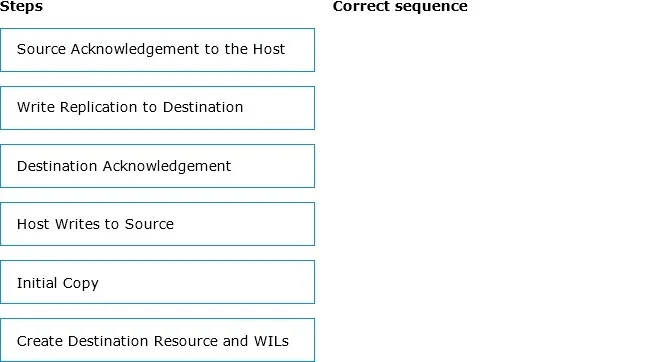
Drag and Drop Question What is the correct sequence of steps for the synchronous replication process on a Dell Unity XT system? Answer: Exam Questions, Study Guides, Practice Tests. Lead the way to…
The correct answer is Create Destination Resource and WILS; Initial Copy; Host Writes to Source; Write Replication to Destination; Destination Acknowledgement; Source Acknowledgement to the Host. Dell Unity XT Synchronous Replication - Step-by-Step Breakdown Core Concept Synchronous replication guarantees zero RPO (Recovery Point Objective): the host receives a write acknowledgement only after data is committed on both source and destination. Every step below enforces…
Question
Drag and Drop Question What is the correct sequence of steps for the synchronous replication process on a Dell Unity XT system? Answer:
Exam Questions, Study Guides, Practice Tests. Lead the way to help you pass any IT Certification exams, 100% Pass Guaranteed or Full Refund. Especially Cisco, Microsoft, CompTIA, Citrix, EMC, HP, Oracle, VMware, Juniper, Check Point, LPI, Nortel, EXIN and so on. Our Slogan: First Test, First Pass. Help you to pass any IT Certification exams at the first try. You can reach us at any of the email addresses listed below. Any problems about IT certification or our products, you could rely upon us, we will give you satisfactory answers in 24 hours.
Exhibit
Answer Area
Drag items
Correct arrangement
- Create Destination Resource and WILS
- Initial Copy
- Host Writes to Source
- Write Replication to Destination
- Destination Acknowledgement
- Source Acknowledgement to the Host
Explanation
Dell Unity XT Synchronous Replication - Step-by-Step Breakdown
Core Concept
Synchronous replication guarantees zero RPO (Recovery Point Objective): the host receives a write acknowledgement only after data is committed on both source and destination. Every step below enforces this guarantee.
Step-by-Step Explanation
1. Create Destination Resource and WILS
Infrastructure must exist before data can flow.
Before replication starts, you must provision the destination volume/LUN on the remote array and establish a Write Intent Log Session (WILS). The WILS tracks writes that arrive during the baseline copy so nothing is lost or missed. No replication is possible without this foundation.
2. Initial Copy
Establish a synchronized baseline.
The entire source dataset is copied to the destination to bring both arrays to a common starting point. Any new writes during this phase are tracked by the WILS and applied afterward. Only once this baseline is complete does the system enter active synchronous mode.
3. Host Writes to Source
Normal I/O begins the replication chain.
A host issues a write to the source array. The source does not acknowledge it yet - it must first propagate the write to the destination.
4. Write Replication to Destination
The defining characteristic of synchronous replication.
The source array immediately forwards the write to the destination over the replication link. The host is held in a pending state until this step and the next complete. This is what differentiates synchronous from asynchronous (which would acknowledge the host first and replicate later).
5. Destination Acknowledgement
Destination confirms data is committed.
The destination array writes the data to its storage and sends an acknowledgement back to the source. The source cannot proceed until it receives this confirmation - guaranteeing the destination is never behind.
6. Source Acknowledgement to the Host
Host is released only after full dual-commit.
Only after receiving the destination's acknowledgement does the source tell the host the write is complete. From the host's perspective, the I/O simply took slightly longer - it has no visibility into the replication handshake.
Common Mistakes / Misconceptions
| Misconception | Reality |
|---|---|
| Host is acknowledged after the source writes, before the destination | That is asynchronous replication - synchronous requires destination commit first |
| WILS creation can happen after Initial Copy | WILS must exist before Initial Copy to track in-flight writes during baseline sync |
| Initial Copy and resource creation can be swapped | You cannot copy data to a resource that doesn't exist yet |
| Destination Acknowledgement is optional | Without it, the source has no proof the destination committed - the RPO guarantee breaks |
Memory Aid
Think of it as a two-party contract: the host only gets a receipt after both parties have signed. Steps 1–2 are setup; steps 3–6 repeat for every write during active replication.
Topics
Community Discussion
No community discussion yet for this question.