
CV0-004 · Question #256
An administrator configures three subnets to the corporate network. All servers should communicate with the main corporate network and access the internet. The administrator creates the following…
The correct answer is B. Replace destination 192.168.1.0/24 with destination 192.168.0.0/24. To allow three subnets to communicate with the main corporate network and access the internet, the routing table needs a more generalized route to the corporate network by using a broader CIDR block.
Question
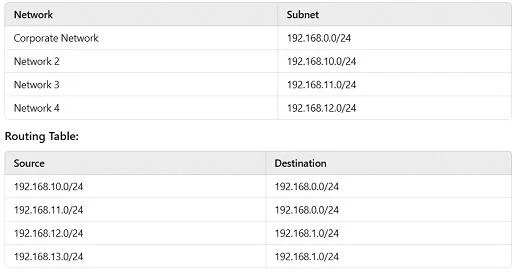
An administrator configures three subnets to the corporate network. All servers should communicate with the main corporate network and access the internet. The administrator creates the following configurations:
After configuring the networks, the administrator recognizes an issue with the configuration. Which of the following can the administrator change in one step to accomplish the goal?
Exhibit
Options
- ARemove source 192.168.12.0/24 and destination 192.168.1.0/24 from the routing table.
- BReplace destination 192.168.1.0/24 with destination 192.168.0.0/24.
- CAdd source 192.168.12.0/24 and destination 192.168.0.0/24 to the routing table.
- DReconfigure Network 4 to 192.168.13.0/24.
How the community answered
(37 responses)- A5% (2)
- B73% (27)
- C14% (5)
- D8% (3)
Why each option
To allow three subnets to communicate with the main corporate network and access the internet, the routing table needs a more generalized route to the corporate network by using a broader CIDR block.
Removing specific routes would hinder communication, not enable it, and the goal is to enable communication for all servers.
The problem states multiple subnets need to communicate with the 'main corporate network,' implying a broader network range than a single subnet. By replacing the destination 192.168.1.0/24 with 192.168.0.0/24, the routing table establishes a route to the entire 192.168.0.0/24 network, which is a common CIDR block encompassing multiple subnets within a corporate network, thus enabling communication for all relevant subnets in one step.
Adding a source and destination route for 192.168.0.0/24 might be partially correct, but replacing an existing, overly specific route is a more precise 'one step' fix for a misconfiguration, assuming a specific route already exists.
Reconfiguring Network 4 to a different IP range does not address routing table issues for existing subnets to communicate with the main corporate network or the internet; it changes a network's identity, which is not the core problem.
Concept tested: IP routing table configuration (CIDR)
Source: https://www.cisco.com/c/en/us/td/docs/ios-xml/ios/iproute/configuration/xe-3s/ire-xe-3s-book/ire-static-route-xe.html
Topics
Community Discussion
No community discussion yet for this question.