
CSSGB · Question #15
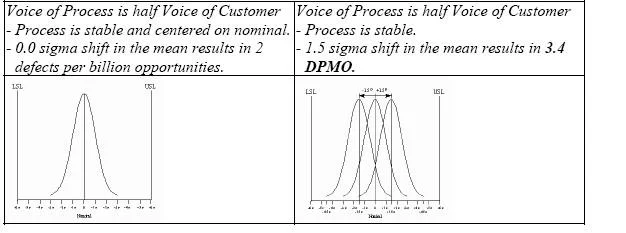
Explain the origin of the "6" and "3.4" in Six Sigma management. Use a diagram that includes the Voice of the Customer and the Voice of the Process. Answer: Through the continuous process…
The correct answer is A. Through the continuous process improvement, the variation of process is reduced. Thus, the relationship between Voice of Customer and Voice of Process moves to a better level, Voice of Process is half the Voice of Customer, that is --- the process improves from a 3- sigma process to a 6- sigma process. Option A is correct because it accurately captures both numbers in Six Sigma's name: the "6" comes from the goal of fitting 6 standard deviations (sigma) of process variation within the customer's tolerance band, meaning the Voice of the Process (VOP) is compressed to half the…
Question
Explain the origin of the "6" and "3.4" in Six Sigma management. Use a diagram that includes the Voice of the Customer and the Voice of the Process. Answer:
Through the continuous process improvement, the variation of process is reduced. Thus, the relationship between Voice of Customer and Voice of Process moves to a better level, Voice of Process is half the Voice of Customer, that is --- the process improves from a 3- sigma process to a 6- sigma process.
Exhibit
Options
- AThrough the continuous process improvement, the variation of process is reduced. Thus, the relationship between Voice of Customer and Voice of Process moves to a better level, Voice of Process is half the Voice of Customer, that is --- the process improves from a 3- sigma process to a 6- sigma process.
How the community answered
(38 responses)- A100% (38)
Explanation
Option A is correct because it accurately captures both numbers in Six Sigma's name: the "6" comes from the goal of fitting 6 standard deviations (sigma) of process variation within the customer's tolerance band, meaning the Voice of the Process (VOP) is compressed to half the width of the Voice of the Customer (VOC) - compared to a baseline 3-sigma process where VOP equals VOC. The "3.4" refers to the resulting defect rate of 3.4 defects per million opportunities (DPMO), derived by incorporating Motorola's empirical finding that long-term processes shift by ±1.5 sigma, so a true 6-sigma process effectively performs at 4.5 sigma dynamically, yielding 3.4 DPMO. Since this is a single-option question, there are no distractors to refute, but common misconceptions include thinking "6" simply means six steps in a process or that 3.4 is a sigma value rather than a defect rate. Memory tip: Visualize two bell curves - a wide one (3σ, VOP = VOC) and a narrow one (6σ, VOP = ½ VOC) - and remember "half the spread, millions of times better" to link the "6" (tighter variation) to the "3.4" (near-perfect quality at 3.4 DPMO).
Topics
Community Discussion
No community discussion yet for this question.