
CBAP · Question #441
A business analyst (BA) is working on a payment system (PS) implementation. A set of systems which should interact with a new system has been identified. The business analyst defined that a user…
The correct answer is A. Option A. The <<include>> relationship applies between 'Change system parameters' and 'Pass two-factor authentication' because authentication is always required before the system parameters can be changed.
Question
A business analyst (BA) is working on a payment system (PS) implementation. A set of systems which should interact with a new system has been identified. The business analyst defined that a user with role of "Supervisor" in the PS must pass a two-factor authentication before an execution of the functions: "Change system parameters" and "Set up new supervisor." A user must have the role of "Supervisor" to use the standard functions "Send mail notification" or "Send SMS notification". The BA defined the following use cases:
- "Change system parameters"
- "Setup new supervisor"
- "Send mail notification"
- "Send SMS notification"
- "Send notification"
- "Pass a two-factor authentication"
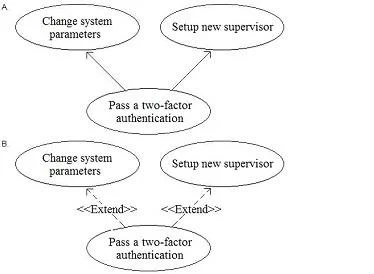
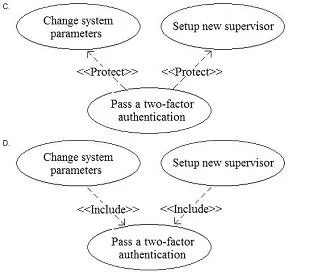
The BA wants to create a Use Case diagram. What standard relationship should be defined between "Change system parameters", "Setup new supervisor" and "Pass a two-factor authentication"?
Exhibits
Options
- AOption A
- BOption B
- COption C
- DOption D
How the community answered
(59 responses)- A71% (42)
- B17% (10)
- C3% (2)
- D8% (5)
Why each option
The <<include>> relationship applies between 'Change system parameters' and 'Pass two-factor authentication' because authentication is always required before the system parameters can be changed.
An <<include>> relationship signifies that the base use case unconditionally delegates part of its behavior to another use case during execution. Because the requirement mandates two-factor authentication as a prerequisite to 'Change system parameters', the base use case always includes the authentication flow - there is no scenario where parameters can change without it. Option A correctly shows the <<include>> arrow pointing from 'Change system parameters' to 'Pass two-factor authentication', reflecting this enforced behavioral dependency.
This option likely depicts an <<extend>> relationship, which is reserved for optional or condition-triggered additions to a base use case, but authentication here is mandatory and unconditional.
This option likely shows an incorrect arrow direction or stereotype, reversing the dependency or using a relationship type that does not represent mandatory inclusion.
This option likely depicts generalization or a plain association, neither of which correctly models the required invocation of authentication within the parameter-change use case.
Concept tested: UML <<include>> relationship for mandatory authentication prerequisite
Source: https://www.omg.org/spec/UML/2.5.1/
Topics
Community Discussion
No community discussion yet for this question.