
CAS-003 · Question #878
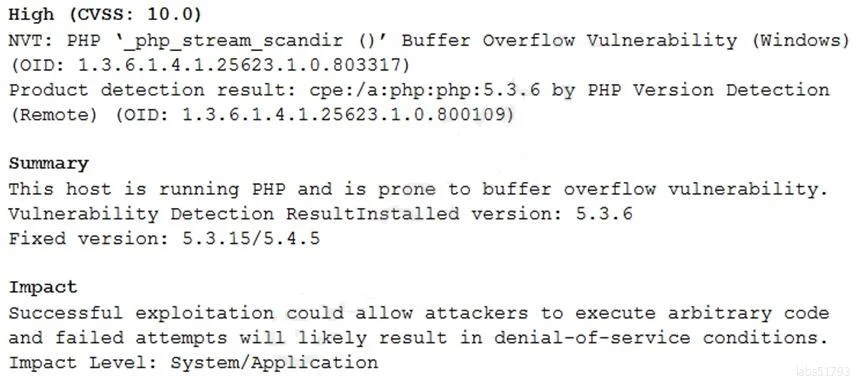
A Chief Information Security Officer (CISO) is developing corrective-action plans based on the following output from a vulnerability scan of internal hosts: Which of the following is the MOST…
The correct answer is A. The product owner should perform a business impact assessment regarding the ability to. When a vulnerability scan reveals findings on critical internal systems, the product owner must perform a business impact assessment to weigh operational risk against patching disruption before remediation proceeds.
Question
A Chief Information Security Officer (CISO) is developing corrective-action plans based on the following output from a vulnerability scan of internal hosts:
Which of the following is the MOST appropriate corrective action to document for this finding?
Exhibit
Options
- AThe product owner should perform a business impact assessment regarding the ability to
- BThe application developer should use a static code analysis tool to ensure any application code is
- CThe systems administrator should evaluate dependencies and perform upgrades as necessary.
- DThe security operations center should develop a custom IDS rule set to prevent attacks using
How the community answered
(51 responses)- A84% (43)
- B2% (1)
- C10% (5)
- D4% (2)
Why each option
When a vulnerability scan reveals findings on critical internal systems, the product owner must perform a business impact assessment to weigh operational risk against patching disruption before remediation proceeds.
A business impact assessment by the product owner is the most appropriate corrective action because vulnerability findings on internal hosts often affect systems critical to business continuity, where immediate patching may cause downtime or service disruption. The product owner is best positioned to evaluate whether the organization can tolerate the residual risk of leaving the vulnerability unpatched versus the impact of applying a fix. This assessment drives an informed, risk-based remediation decision aligned with business priorities.
Static code analysis addresses weaknesses in application source code, but a vulnerability scan finding on an internal host is most likely an infrastructure or OS-level issue that static analysis tooling cannot detect or remediate.
Evaluating dependencies and upgrading is a valid technical remediation step, but it should follow a business impact assessment so the organization understands operational consequences before making potentially disruptive system changes.
Developing a custom IDS rule set is a detective and compensating control, not a corrective action - it may reduce exposure temporarily but does not remediate the underlying vulnerability identified by the scan.
Concept tested: Risk-based vulnerability remediation and business impact assessment
Source: https://nvlpubs.nist.gov/nistpubs/SpecialPublications/NIST.SP.800-40r4.pdf
Topics
Community Discussion
No community discussion yet for this question.