
CAS-003 · Question #557
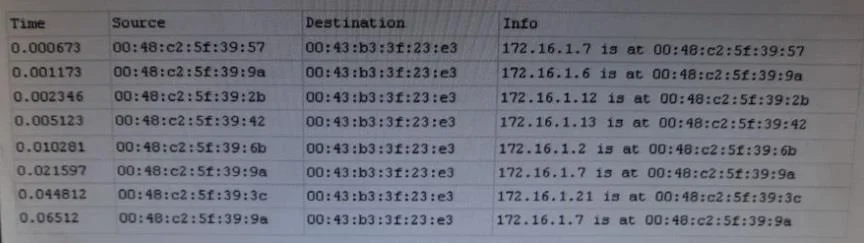
A cybersecurity analyst is conducting packet analysis on the following: Which of the following is occurring in the given packet capture?
The correct answer is A. ARP spoofing. ARP (Address Resolution Protocol) spoofing involves an attacker sending forged or gratuitous ARP reply packets on a local network segment to associate their MAC address with a legitimate IP address (such as a gateway). In a packet capture, this manifests as multiple ARP replies…
Question
A cybersecurity analyst is conducting packet analysis on the following:
Which of the following is occurring in the given packet capture?
Exhibit
Options
- AARP spoofing
- BBroadcast storm
- CSmurf attack
- DNetwork enurneration
- EZero-day exploit
How the community answered
(33 responses)- A79% (26)
- C6% (2)
- D12% (4)
- E3% (1)
Explanation
ARP (Address Resolution Protocol) spoofing involves an attacker sending forged or gratuitous ARP reply packets on a local network segment to associate their MAC address with a legitimate IP address (such as a gateway). In a packet capture, this manifests as multiple ARP replies claiming the same IP address is mapped to different MAC addresses-or a host repeatedly broadcasting unsolicited ARP replies. This poisons the ARP caches of other hosts, enabling man-in-the-middle interception of traffic. The other options involve different traffic patterns: a broadcast storm shows exponentially growing broadcast frames, a Smurf attack uses ICMP echo requests to broadcast addresses, network enumeration shows systematic probing of ports/addresses, and a zero-day exploit would involve specific vulnerability exploitation traffic.
Topics
Community Discussion
No community discussion yet for this question.