C1000-132 · Question #42
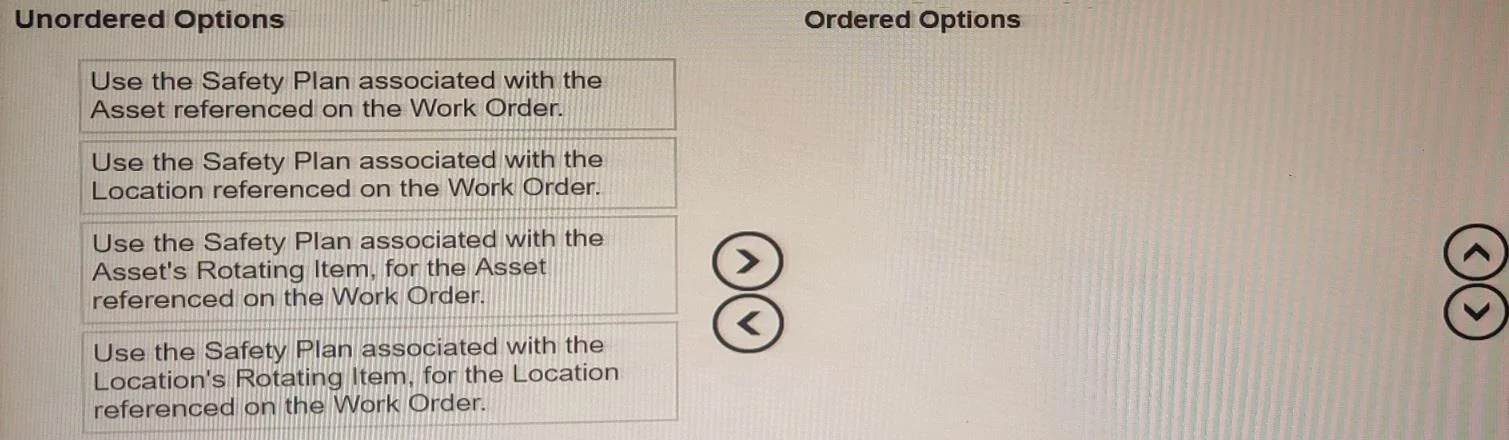
Drag and Drop Question What is the priority order for selecting a Safety Plan when a Job Plan is applied to a Work Order? Answer:
The correct answer is Use the Safety Plan associated with the Asset referenced on the Work Order.; Use the Safety Plan associated with the Location referenced on the Work Order.; Use the Safety Plan associated with the Asset's Rotating Item, for the Asset referenced on the Work Order.; Use the Safety Plan associated with the Location's Rotating Item, for the Location referenced on the Work Order.. Safety Plan Priority Order When a Job Plan is Applied to a Work Order This question tests your understanding of specificity hierarchy - the system resolves the Safety Plan by starting with the most direct, specific reference and falling back to progressively less specific ones. -
Question
Exhibit
Answer Area
Drag items
Correct arrangement
- Use the Safety Plan associated with the Asset referenced on the Work Order.
- Use the Safety Plan associated with the Location referenced on the Work Order.
- Use the Safety Plan associated with the Asset's Rotating Item, for the Asset referenced on the Work Order.
- Use the Safety Plan associated with the Location's Rotating Item, for the Location referenced on the Work Order.
Explanation
Safety Plan Priority Order When a Job Plan is Applied to a Work Order
This question tests your understanding of specificity hierarchy - the system resolves the Safety Plan by starting with the most direct, specific reference and falling back to progressively less specific ones.
The Core Logic
The priority follows two rules applied in combination:
- Direct reference beats indirect reference (Asset/Location > Rotating Item)
- Asset beats Location (you are working on the asset, which is at a location)
Item-by-Item Breakdown
#1 - Asset referenced on the Work Order The asset is the direct object of the work. A Safety Plan tied specifically to that asset is the most targeted match possible. This is the most granular level of specificity, so it wins first.
#2 - Location referenced on the Work Order If no Safety Plan is found on the asset itself, the system looks at the location where the work occurs. This is still a direct reference, just one level broader. Location is checked after Asset because the asset is the primary subject of the work order.
#3 - Rotating Item associated with the Asset A Rotating Item is a "type" or "template" record - it represents a class of equipment, not a specific instance. If neither the asset nor the location has a Safety Plan, the system checks whether the asset belongs to a Rotating Item that does. This is an indirect reference via the asset, so it ranks below both direct references.
#4 - Rotating Item associated with the Location The least specific option: an indirect reference (Rotating Item) through the broadest entity (Location). This is the final fallback.
Summary Table
| Priority | Reference Type | Entity |
|---|---|---|
| 1 | Direct | Asset |
| 2 | Direct | Location |
| 3 | Indirect (Rotating Item) | Asset |
| 4 | Indirect (Rotating Item) | Location |
Common Mistakes
- Putting Location before Asset - Asset is the primary subject of work; location is secondary.
- Putting Rotating Items above direct references - Rotating Items are generic type-level records; direct Asset/Location records always win.
- Swapping #3 and #4 - Even among Rotating Items, the asset's type is more specific to the job than the location's type.
Topics
Community Discussion
No community discussion yet for this question.