nerdexam
Microsoft

AZ-500 · Question #5

Case Study 1 - Litware, Inc Overview Litware, Inc. is a digital media company that has 500 employees in the Chicago area and 20 employees in the San Francisco area. Existing Environment Litware has…

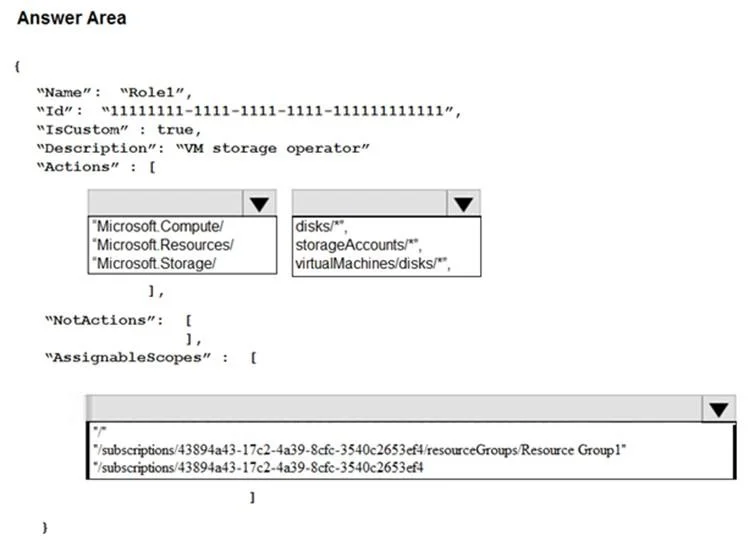
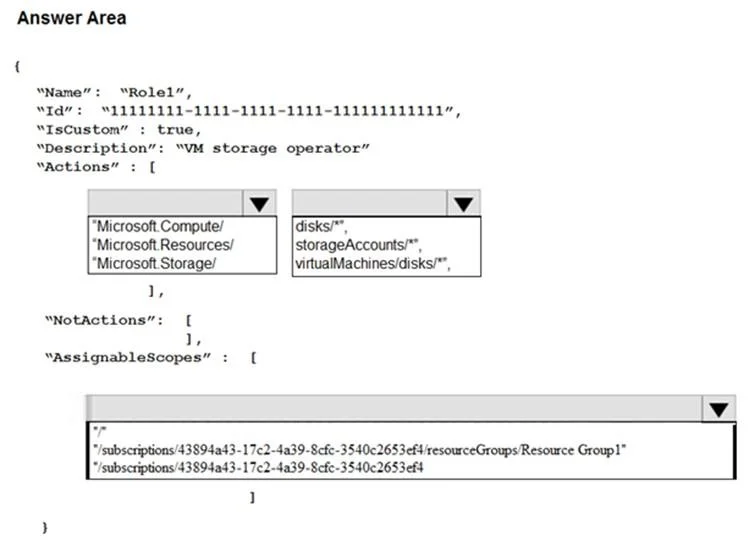
The correct answer is Actions: Resource Provider: Microsoft.Storage/; Actions: Resource Type/Action: virtualMachines/disks/*; Assignable Scopes: /subscriptions/43894a43-17c2-4a39-8cfc-3540c2653ef4. This hotspot question tests knowledge of Azure AD and Azure RBAC configurations required to meet Litware's identity and access requirements, including PIM assignments, group membership rules, and application registration restrictions.

Submitted by chiamaka_o· Mar 6, 2026Secure compute, storage, and databases

Question

Case Study 1 - Litware, Inc Overview Litware, Inc. is a digital media company that has 500 employees in the Chicago area and 20 employees in the San Francisco area. Existing Environment Litware has an Azure subscription named Sub1 that has a subscription ID of 43894a43-17c2- 4a39-8cfc-3540c2653ef4. Sub1 is associated to an Azure Active Directory (Azure AD) tenant named litwareinc.com. The tenant contains the user objects and the device objects of all the Litware employees and their devices. Each user is assigned an Azure AD Premium P2 license. Azure AD Privileged Identity Management (PIM) is activated. The tenant contains the groups shown in the following table. The Azure subscription contains the objects shown in the following table. Azure Security Center is set to the Free tier. Planned changes Litware plans to deploy the Azure resources shown in the following table. Litware identifies the following identity and access requirements: All San Francisco users and their devices must be members of Group1. The members of Group2 must be assigned the Contributor role to Resource Group2 by using a permanent eligible assignment. Users must be prevented from registering applications in Azure AD and from consenting to applications that access company information on the users' behalf. Platform Protection Requirements Litware identifies the following platform protection requirements: Microsoft Antimalware must be installed on the virtual machines in Resource Group1. The members of Group2 must be assigned the Azure Kubernetes Service Cluster Admin Role. Azure AD users must be to authenticate to AKS1 by using their Azure AD credentials. Following the implementation of the planned changes, the IT team must be able to connect to VM0 by using JIT VM access. A new custom RBAC role named Role1 must be used to delegate the administration of the managed disks in Resource Group1. Role1 must be available only for Resource Group1. Security Operations Requirements Litware must be able to customize the operating system security configurations in Azure Security Center. Hotspot Question You need to create Role1 to meet the platform protection requirements. How should you complete the role definition of Role1? To answer, select the appropriate options in the answer area. NOTE: Each correct selection is worth one point. Answer:

Exhibits

AZ-500 question #5 exhibit 1
AZ-500 question #5 exhibit 2

Answer Area

  • Actions: Resource ProviderMicrosoft.Storage/
    Microsoft.Compute/Microsoft.Resources/Microsoft.Storage/
  • Actions: Resource Type/ActionvirtualMachines/disks/*
    disks/*storageAccounts/*virtualMachines/disks/*
  • Assignable Scopes/subscriptions/43894a43-17c2-4a39-8cfc-3540c2653ef4
    //subscriptions/43894a43-17c2-4a39-8cfc-3540c2653ef4/resourceGroups/Resource Group1/subscriptions/43894a43-17c2-4a39-8cfc-3540c2653ef4

Explanation

This hotspot question tests knowledge of Azure AD and Azure RBAC configurations required to meet Litware's identity and access requirements, including PIM assignments, group membership rules, and application registration restrictions.

Approach. For the San Francisco users/devices in Group1, a dynamic membership rule should be used (e.g., based on location attribute), making it a Dynamic group. For Group2's Contributor role on Resource Group2, PIM's 'permanent eligible' assignment means the assignment never expires but users must still activate it - this is configured in PIM as an eligible assignment with no end date. To prevent users from registering applications, the Azure AD tenant setting 'Users can register applications' must be set to 'No' under Azure AD > User Settings, which restricts app registration to administrators only.

Concept tested. Azure AD group types (dynamic vs assigned), Azure AD Privileged Identity Management (PIM) eligible vs active and permanent vs time-bound assignments, and Azure AD user settings for application registration restrictions.

Reference. https://learn.microsoft.com/en-us/azure/active-directory/privileged-identity-management/pim-resource-roles-assign-roles and https://learn.microsoft.com/en-us/azure/active-directory/fundamentals/users-default-permissions

Topics

#Azure security#case study

Community Discussion

No community discussion yet for this question.

Full AZ-500 Practice