
AZ-500 · Question #366
Hotspot Question You have an Azure Active Directory (Azure AD) tenant that contains the users shown in the following table. You create and enforce an Azure AD Identity Protection sign-in risk policy…
This question tests understanding of Azure AD Identity Protection sign-in risk policies, specifically how Include/Exclude group assignments interact and what behavior each user experiences based on their group membership.
Question
Exhibit
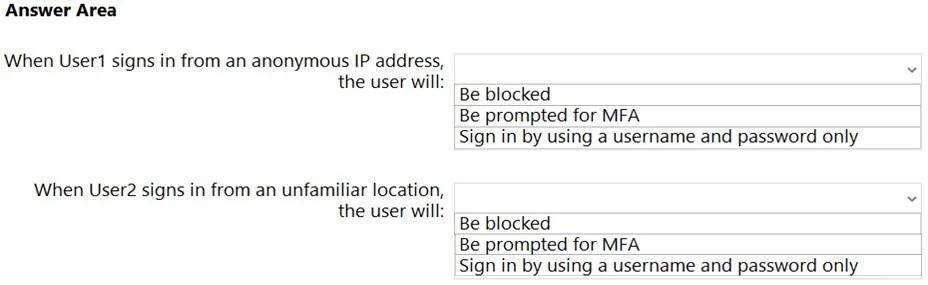
Answer Area
- When User1 signs in from an anonymous IP address, the user will:Be blockedBe prompted for MFASign in by using a username and password only
- When User2 signs in from an unfamiliar location, the user will:Be blockedBe prompted for MFASign in by using a username and password only
Explanation
This question tests understanding of Azure AD Identity Protection sign-in risk policies, specifically how Include/Exclude group assignments interact and what behavior each user experiences based on their group membership.
Approach. The policy includes Group1 and excludes Group2. A user in Group1 only will be subject to the policy and must complete MFA when sign-in risk is Low or above. A user in both Group1 and Group2 will be EXCLUDED from the policy (exclusions take precedence over inclusions), so they can sign in without MFA regardless of risk level. A user in neither group is not included in the policy scope, so they also sign in without the MFA requirement. A user in Group2 only is explicitly excluded, so they sign in without MFA enforcement. The key principle is: exclusions always override inclusions in Azure AD Identity Protection policies, and a user must be in the included group AND NOT in the excluded group to be subject to the policy controls.
Concept tested. Azure AD Identity Protection sign-in risk policy assignment logic - specifically how Include and Exclude group settings interact, where exclusions take precedence over inclusions, determining which users are subject to MFA requirements based on sign-in risk levels.
Topics
Community Discussion
No community discussion yet for this question.