
AZ-500 · Question #24
You are testing an Azure Kubernetes Service (AKS) cluster. The cluster is configured as shown in the exhibit. You plan to deploy the cluster to production. You disable HTTP application routing. You…
The correct answer is A. Create an AKS Ingress controller. Explanation Creating an AKS Ingress Controller (Option A) is correct because it acts as a reverse proxy that routes external HTTP/HTTPS traffic to internal services using a single IP address, while also handling TLS termination - exactly what the question requires after…
Question
Exhibits
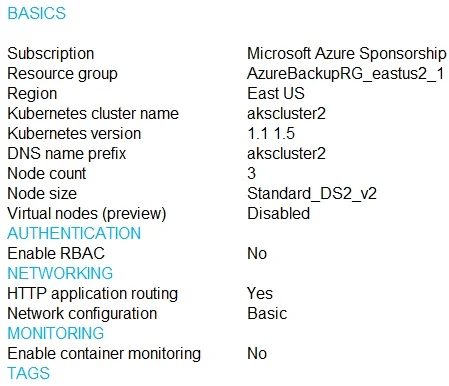
Options
- ACreate an AKS Ingress controller.
- BInstall the container network interface (CNI) plug-in.
- CCreate an Azure Standard Load Balancer.
- DCreate an Azure Basic Load Balancer.
How the community answered
(50 responses)- A70% (35)
- B18% (9)
- C8% (4)
- D4% (2)
Explanation
Explanation
Creating an AKS Ingress Controller (Option A) is correct because it acts as a reverse proxy that routes external HTTP/HTTPS traffic to internal services using a single IP address, while also handling TLS termination - exactly what the question requires after disabling the built-in HTTP application routing add-on.
Option B is wrong because the CNI plug-in is a network interface component that handles pod-level networking and IP assignment within the cluster - it does not provide reverse proxy functionality or TLS termination. Option C is wrong because an Azure Standard Load Balancer operates at Layer 4 (TCP/UDP) and can distribute traffic, but it cannot perform TLS termination or path-based routing with a single IP the way an Ingress controller can. Option D is wrong for the same reasons as Option C, and additionally, Azure Basic Load Balancers are limited in features and not recommended for production AKS workloads.
Memory Tip: Think of the Ingress Controller as the "smart traffic cop" for your cluster - it sits at a single door (IP), reads the destination on each request (Layer 7), strips the TLS envelope, and directs traffic to the right service. Load Balancers just forward packets blindly; Ingress Controllers understand the traffic.
Topics
Community Discussion
No community discussion yet for this question.