
AZ-400 · Question #293
Hotspot Question You are designing YAML-based Azure pipelines for the apps shown in the following table. You need to configure the YAML strategy value for each app. The solution must minimize app…
The correct answer is App1: Rolling; App2: Canary. This question tests knowledge of Azure Pipelines YAML deployment strategies (canary, rolling, runOnce) and which strategy minimizes downtime for different application types.
Question
Exhibits
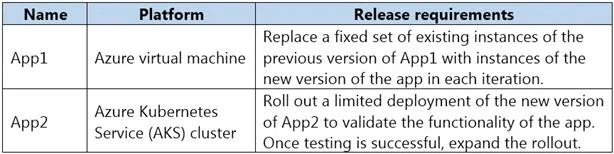
Answer Area
- App1RollingRollingCanaryBlue/GreenRecreate
- App2CanaryRollingCanaryBlue/GreenRecreate
Explanation
This question tests knowledge of Azure Pipelines YAML deployment strategies (canary, rolling, runOnce) and which strategy minimizes downtime for different application types.
Approach. Azure Pipelines supports three deployment strategies: 'runOnce' (deploys once, no special downtime handling), 'rolling' (replaces instances incrementally, suitable for apps with multiple instances like a web app on multiple VMs to minimize downtime), and 'canary' (gradually shifts traffic to the new version, ideal for apps requiring zero-downtime deployments with traffic splitting such as Kubernetes-hosted apps). For an app requiring gradual traffic shifting (e.g., a Kubernetes app), 'canary' minimizes downtime by routing a small percentage of traffic first. For an app with multiple slots or instances (e.g., a web app with multiple VMs or deployment slots), 'rolling' minimizes downtime by updating one instance at a time. For a simple single-instance app where downtime is acceptable or managed externally, 'runOnce' is used, though it does not inherently minimize downtime.
Concept tested. Azure Pipelines YAML deployment strategies: understanding when to use 'canary' (gradual traffic shifting, zero-downtime for traffic-split capable environments like Kubernetes), 'rolling' (incremental instance updates for multi-instance apps), and 'runOnce' (single deployment pass, no downtime mitigation built-in).
Topics
Community Discussion
No community discussion yet for this question.