
AZ-305 · Question #92
Hotspot Question You need to recommend an Azure Storage Account configuration for two applications named Application1 and Applications. The configuration must meet the following requirements…
This hotspot question tests knowledge of Azure Storage Account types, performance tiers, redundancy options, and blob access tiers to meet specific performance, cost, and availability requirements.
Question
Exhibit
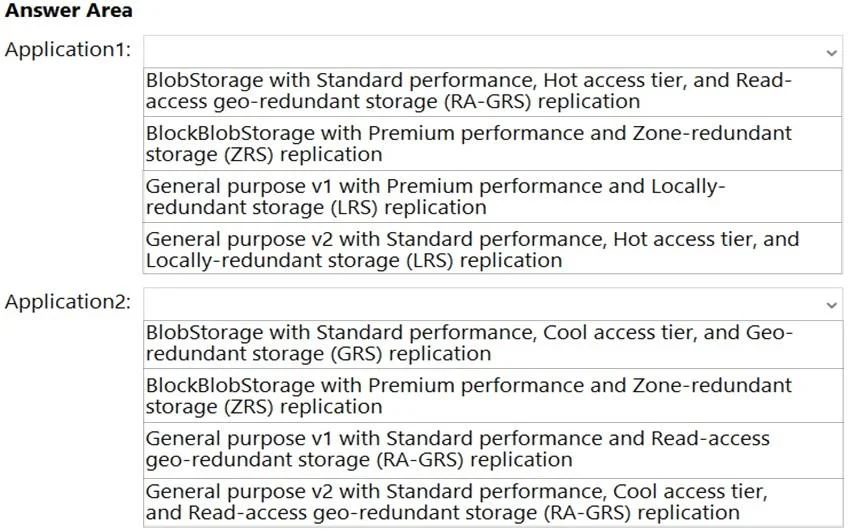
Answer Area
- Application1:BlobStorage with Standard performance, Hot access tier, and Read-access geo-redundant storage (RA-GRS) replicationBlockBlobStorage with Premium performance and Zone-redundant storage (ZRS) replicationGeneral purpose v1 with Premium performance and Locally-redundant storage (LRS) replicationGeneral purpose v2 with Standard performance, Hot access tier, and Locally-redundant storage (LRS) replication
- Application2:BlobStorage with Standard performance, Cool access tier, and Geo-redundant storage (GRS) replicationBlockBlobStorage with Premium performance and Zone-redundant storage (ZRS) replicationGeneral purpose v1 with Standard performance and Read-access geo-redundant storage (RA-GRS) replicationGeneral purpose v2 with Standard performance, Cool access tier, and Read-access geo-redundant storage (RA-GRS) replication
Explanation
This hotspot question tests knowledge of Azure Storage Account types, performance tiers, redundancy options, and blob access tiers to meet specific performance, cost, and availability requirements.
Approach. For Application1 (highest transaction rates, lowest latency): Use a Premium performance tier with BlockBlobStorage account kind, paired with Zone-Redundant Storage (ZRS) or Geo-Zone-Redundant Storage (GZRS) for datacenter failure availability. Premium block blob storage provides the lowest latency and highest IOPS for transaction-intensive workloads. For Application2 (lowest storage cost per GB): Use a Standard performance tier with StorageV2 (general-purpose v2) account kind using the Cool or Archive access tier, with Geo-Redundant Storage (GRS) or GZRS redundancy - GRS/GZRS ensures availability during datacenter failure while Cool tier minimizes per-GB storage costs. Both applications being 'optimized for uploads and downloads' aligns with Block Blob storage type. The key differentiator is Premium (BlockBlobStorage) for Application1's performance needs vs Standard with Cool tier for Application2's cost optimization.
Concept tested. Azure Storage Account types (Premium BlockBlobStorage vs Standard StorageV2), performance tiers, blob access tiers (Hot/Cool/Archive), and redundancy options (LRS, ZRS, GRS, GZRS) and their trade-offs between cost, performance, and availability.
Reference. https://learn.microsoft.com/en-us/azure/storage/common/storage-account-overview
Topics
Community Discussion
No community discussion yet for this question.