nerdexam
MicrosoftMicrosoft

AZ-305 · Question #70

AZ-305 Question #70: Real Exam Question with Answer & Explanation

This hotspot question tests knowledge of Azure RBAC custom roles, Conditional Access policies, and hybrid Azure AD join requirements for securing production environment access through the Azure portal.

Submitted by daniela_cl· Mar 6, 2026Design infrastructure solutions

Question

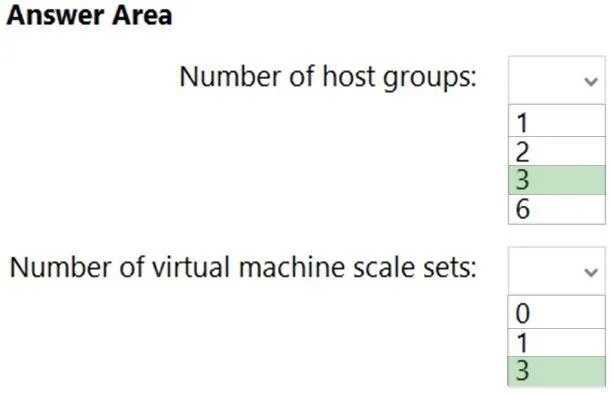
Case Study 1 - Litware Existing Environment Azure Environment Litware has 10 Azure subscriptions that are linked to the Litware.com tenant and five Azure subscriptions that are linked to the dev.litware.com tenant. All the subscriptions are in an Enterprise Agreement (EA). The litware.com tenant contains a custom Azure role-based access control (Azure RBAC) role named Role1 that grants the DataActions read permission to the blobs and files in Azure Storage. On-Premises Environment The on-premises network of Litware contains the resources shown in the following table. Network Environment Litware has ExpressRoute connectivity to Azure. Planned Changes and Requirements Litware plans to implement the following changes: Migrate DB1 and DB2 to Azure. Migrate App1 to Azure virtual machines. Migrate the external storage used by App1 to Azure Storage. Deploy the Azure virtual machines that will host App1 to Azure dedicated hosts. Authentication and Authorization Requirements Litware identifies the following authentication and authorization requirements: Only users that manage the production environment by using the Azure portal must connect from a hybrid Azure AD-joined device and authenticate by using Azure Multi-Factor Authentication (MFA). The Network Contributor built-in RBAC role must be used to grant permissions to the network administrators for all the virtual networks in all the Azure subscriptions. To access the resources in Azure, App1 must use the managed identity of the virtual machines that will host the app. RBAC roles must be applied at the highest level possible. Resiliency Requirements Litware identifies the following resiliency requirements: Once migrated to Azure, DB1 and DB2 must meet the following requirements: - Maintain availability if two availability zones in the local Azure region fail. - Fail over automatically. - Minimize I/O latency. App1 must meet the following requirements: - Be hosted in an Azure region that supports availability zones. - Be hosted on Azure virtual machines that support automatic scaling. - Maintain availability if two availability zones in the local Azure region fail. Security and Compliance Requirements Litware identifies the following security and compliance requirements: Once App1 is migrated to Azure, you must ensure that new data can be written to the app, and the modification of new and existing data is prevented for a period of three years. On-premises users and services must be able to access the Azure Storage account that will host the data in App1. Access to the public endpoint of the Azure Storage account that will host the App1 data must be prevented. All Azure SQL databases in the production environment must have Transparent Data Encryption (TDE) enabled. App1 must NOT share physical hardware with other workloads. Business Requirements Litware identifies the following business requirements: Minimize administrative effort. Minimize costs. Hotspot Question You plan to migrate App1 to Azure. You need to recommend a high-availability solution for App1. The solution must meet the resiliency requirements. What should you include in the recommendation? To answer, select the appropriate options in the answer area. NOTE: Each correct selection is worth one point. Answer:

Options

  • __typehotspot
  • variantdropdown

Explanation

This hotspot question tests knowledge of Azure RBAC custom roles, Conditional Access policies, and hybrid Azure AD join requirements for securing production environment access through the Azure portal.

Approach. The correct approach involves understanding that Role1 is a custom RBAC role scoped to DataActions for blobs and files, meaning it can only be assigned within the litware.com tenant and cannot be directly transferred to the dev.litware.com tenant without recreation. For the authentication requirement that production environment users must connect from hybrid Azure AD-joined devices, a Conditional Access policy must be created that targets the production management users and enforces the 'Require Hybrid Azure AD joined device' grant control, scoped specifically to Azure portal access. This ensures only compliant, domain-joined devices can authenticate to manage production resources, satisfying the zero-trust security posture Litware requires.

Concept tested. Azure RBAC custom role scope and tenant boundaries, Conditional Access policy configuration for hybrid Azure AD-joined device compliance, and the relationship between Enterprise Agreement subscriptions and Azure AD tenants in a multi-tenant environment.

Reference. Microsoft Docs: Custom roles in Azure RBAC (https://learn.microsoft.com/en-us/azure/role-based-access-control/custom-roles) and Conditional Access: Require compliant or hybrid Azure AD joined device (https://learn.microsoft.com/en-us/azure/active-directory/conditional-access/howto-conditional-access-policy-compliant-device)

Topics

#Azure Virtual Machines#host groups#virtual machine scale sets#infrastructure scaling

Community Discussion

No community discussion yet for this question.

Full AZ-305 PracticeBrowse All AZ-305 Questions