
AZ-305 · Question #421
Hotspot Question You have an Azure subscription. You plan to host three apps named App1, App2, and App3 by using Azure Container Apps. The apps have the following network requirements: - Implement…
This question tests understanding of Azure Container Apps environments and workload profiles, specifically how network isolation requirements and compute profile types drive the minimum number of environments and profiles needed.
Question
Exhibit
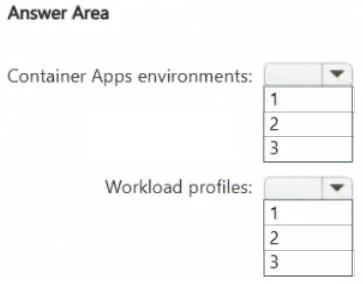
Answer Area
- Container Apps environments:123
- Workload profiles:123
Explanation
This question tests understanding of Azure Container Apps environments and workload profiles, specifically how network isolation requirements and compute profile types drive the minimum number of environments and profiles needed.
Approach. The correct answer is 2 Container Apps environments and 3 workload profiles. App1 and App2 share one environment because they need NSG-based connectivity between them and both allow external inbound via NSGs - they can coexist in the same environment with shared networking. App3 must be fully isolated from App1 and App2 (including network isolation), which requires a separate environment - you cannot achieve full network isolation between apps within the same environment. For workload profiles: within Environment 1, App1 needs a Consumption profile (dynamically allocated compute) and App2 needs a Dedicated D16 profile (general purpose). App3 in Environment 2 needs a Dedicated E16 profile (memory optimized). That gives a minimum of 2 environments and 3 workload profiles (Consumption for App1, Dedicated-D16 for App2, and Dedicated-E16 for App3).
Concept tested. Azure Container Apps environments provide network isolation boundaries - apps in the same environment share a virtual network and can communicate, while separate environments provide full network isolation. Workload profiles define compute characteristics (Consumption = dynamic, Dedicated = reserved instances of specific SKUs), and different SKU types or instance families each require their own workload profile.
Reference. https://learn.microsoft.com/en-us/azure/container-apps/environment and https://learn.microsoft.com/en-us/azure/container-apps/workload-profiles-overview
Topics
Community Discussion
No community discussion yet for this question.