
Microsoft
AZ-305 · Question #396
Hotspot Question You have the following projects: - Project1: A rapidly iterating cloud-based solution that integrates multiple Azure software as a service (SaaS) solutions - Project2: The migration…
The correct answer is Project1: Azure Cosmos DB; Project2: Azure SQL Managed Instance; Project3: Azure SQL Database. Here's the rationale for each project's database solution: Project1: Azure Cosmos DB Requirements: A rapidly iterating cloud-based solution that integrates multiple Azure SaaS solutions, minimize costs, and minimize administrative effort associated with operating system…
Submitted by daniela_cl· Mar 6, 2026Design data storage solutions
Question
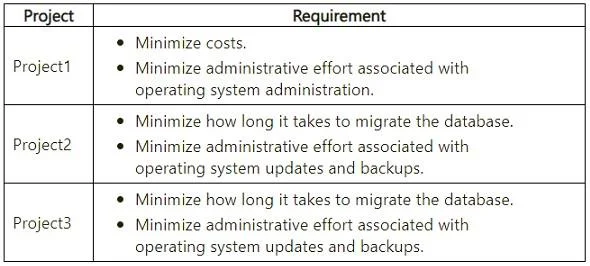
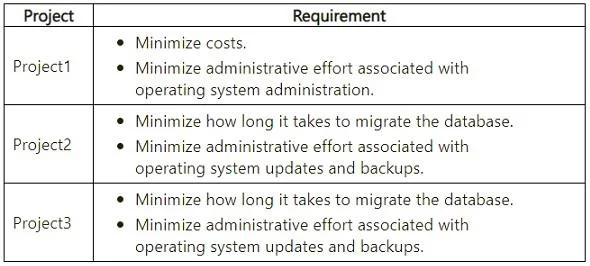
Hotspot Question You have the following projects: - Project1: A rapidly iterating cloud-based solution that integrates multiple Azure software as a service (SaaS) solutions - Project2: The migration of a 5-TB on-premises database to Azure - Project3: The migration of a 30-TB on-premises database to Azure The projects have the requirements shown in the following table. You need to recommend a database solution for the projects. What should you include in the recommendation for each project? To answer, select the appropriate options in the answer area. NOTE: Each correct selection is worth one point. Answer:
Exhibits
Answer Area
- Project1Azure Cosmos DBAzure Cosmos DBAzure SQL DatabaseAzure SQL Managed InstanceSQL Server on Azure Virtual Machines
- Project2Azure SQL Managed InstanceAzure Cosmos DBAzure SQL DatabaseAzure SQL Managed InstanceSQL Server on Azure Virtual Machines
- Project3Azure SQL DatabaseAzure Cosmos DBAzure SQL DatabaseAzure SQL Managed InstanceSQL Server on Azure Virtual Machines
Explanation
Here's the rationale for each project's database solution:
-
Project1: Azure Cosmos DB
- Requirements: A rapidly iterating cloud-based solution that integrates multiple Azure SaaS solutions, minimize costs, and minimize administrative effort associated with operating system administration.
- Rationale: Azure Cosmos DB is a fully managed, globally distributed NoSQL database service. It is ideal for cloud-native, rapidly evolving applications that integrate with other Azure SaaS solutions, as it offers high availability, low latency, and global scale without requiring extensive administrative effort for OS management (being a PaaS/serverless offering). Its flexible data model and various APIs suit rapidly iterating development.
-
Project2: Azure SQL Managed Instance
- Requirements: Migration of a 5-TB on-premises database to Azure, minimize how long it takes to migrate, and minimize administrative effort associated with operating system updates and backups.
- Rationale: As explicitly stated in the provided explanation, "SQL Managed Instance supports database migration from on-premises with minimal to no database changes," which directly addresses the need to minimize migration time. It is a Platform-as-a-Service (PaaS) offering, meaning it handles operating system updates and backups, thus minimizing administrative effort. The 5-TB database size fits within its up to 16-TB limit.
-
Project3: Azure SQL Database
- Requirements: Migration of a 30-TB on-premises database to Azure, minimize how long it takes to migrate, and minimize administrative effort associated with operating system updates and backups.
- Rationale: Azure SQL Database is a fully managed PaaS relational database service. Like Azure SQL Managed Instance, it minimizes administrative effort for OS management, updates, and backups. Crucially, for a 30-TB database, Azure SQL Database (especially with the Hyperscale service tier) can scale to handle much larger databases (up to 100 TB) compared to Azure SQL Managed Instance's 16-TB limit for a single instance. This makes it the appropriate PaaS choice for large-scale migrations while still meeting the requirements to minimize migration time and administrative overhead.
Topics
#Azure database migration#Azure Cosmos DB#Azure SQL Database#Database service selection
Community Discussion
No community discussion yet for this question.