
AZ-305 · Question #331
Hotspot Question You plan to use Azure SQL as a database platform. You need to recommend an Azure SQL product and service tier that meets the following requirements: - Automatically scales compute…
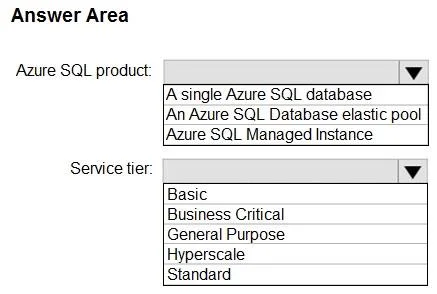
The correct answer is Azure SQL product:: A single Azure SQL database; Service tier:: General Purpose. This question tests knowledge of Azure SQL Database products and service tiers, specifically which combination supports automatic compute scaling and per-second billing.
Question
Exhibit
Answer Area
- Azure SQL product:A single Azure SQL databaseA single Azure SQL databaseAn Azure SQL Database elastic poolAzure SQL Managed Instance
- Service tier:General PurposeBasicBusiness CriticalGeneral PurposeHyperscaleStandard
Explanation
This question tests knowledge of Azure SQL Database products and service tiers, specifically which combination supports automatic compute scaling and per-second billing.
Approach. The correct recommendation is Azure SQL Database (the product) with the Serverless service tier. Azure SQL Database Serverless automatically scales compute resources up and down based on workload demand, so you only use and pay for what you need. It also supports per-second billing for compute, meaning you are billed only for the compute used during active query processing - idle periods can be auto-paused to further reduce costs. No other Azure SQL product (Managed Instance, Elastic Pool with provisioned tiers, or Hyperscale) provides both automatic compute autoscaling and per-second billing in the same way.
Concept tested. Azure SQL Database Serverless tier - understanding that it is the only Azure SQL offering that combines automatic compute autoscaling (scales vCores based on workload demand) with per-second billing, distinguishing it from provisioned tiers (fixed compute, hourly billing), Managed Instance (no serverless autoscale), and other SQL products.
Reference. https://learn.microsoft.com/en-us/azure/azure-sql/database/serverless-tier-overview
Topics
Community Discussion
No community discussion yet for this question.