
AZ-305 · Question #277
Hotspot Question You are designing a cost-optimized solution that uses Azure Batch to run two types of jobs on Linux nodes. The first job type will consist of short-running tasks for a development…
The correct answer is First job:: Batch service and dedicated virtual machines; Second job:: Batch service and dedicated virtual machines. This question tests knowledge of Azure Batch pool types (auto pools vs. user subscription pools) and node types (Spot/Low-priority vs. Dedicated), matching them to workload requirements while minimizing cost and leveraging Azure Hybrid Benefit.
Question
Exhibit
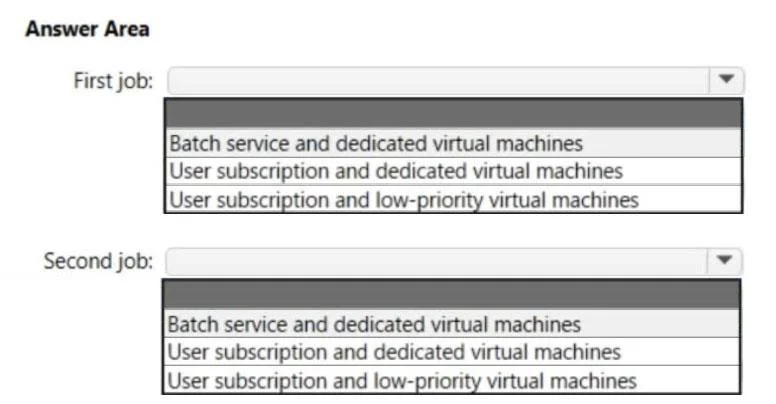
Answer Area
- First job:Batch service and dedicated virtual machinesBatch service and dedicated virtual machinesUser subscription and dedicated virtual machinesUser subscription and low-priority virtual machines
- Second job:Batch service and dedicated virtual machinesBatch service and dedicated virtual machinesUser subscription and dedicated virtual machinesUser subscription and low-priority virtual machines
Explanation
This question tests knowledge of Azure Batch pool types (auto pools vs. user subscription pools) and node types (Spot/Low-priority vs. Dedicated), matching them to workload requirements while minimizing cost and leveraging Azure Hybrid Benefit.
Approach. For the first job type (short-running tasks in a development environment), you should use an Auto Pool with Spot/Low-priority nodes. Auto pools are created automatically when a job is submitted and deleted when the job completes, minimizing idle compute charges - ideal for dev workloads. Spot/Low-priority nodes are significantly cheaper (up to 80% discount) and are acceptable for dev tasks that can tolerate interruption. For the second job type (long-running MPI applications in a production environment requiring timely completion), you should use a User Subscription pool with Dedicated nodes. User Subscription pools are required to leverage Azure Hybrid Benefit (since the VMs appear in your own subscription), and Dedicated nodes guarantee capacity and are never preempted - critical for long-running, time-sensitive MPI production workloads. Azure Hybrid Benefit applies to dedicated nodes in user subscription pools, allowing you to use existing on-premises Windows Server or SQL Server licenses, reducing costs while maintaining reliability.
Concept tested. Azure Batch pool configuration: Auto Pool vs. User Subscription Pool, and Spot/Low-priority nodes vs. Dedicated nodes - matched to workload characteristics (dev/short vs. prod/long-running MPI), cost optimization strategies, and Azure Hybrid Benefit eligibility requirements.
Reference. https://docs.microsoft.com/en-us/azure/batch/batch-pool-no-public-ip-address, https://docs.microsoft.com/en-us/azure/batch/nodes-and-pools, https://docs.microsoft.com/en-us/azure/batch/batch-spot-vms
Topics
Community Discussion
No community discussion yet for this question.