
AZ-305 · Question #257
Hotspot Question You are designing a data storage solution to support reporting. The solution will ingest high volumes of data in the JSON format by using Azure Event Hubs. As the data arrives…
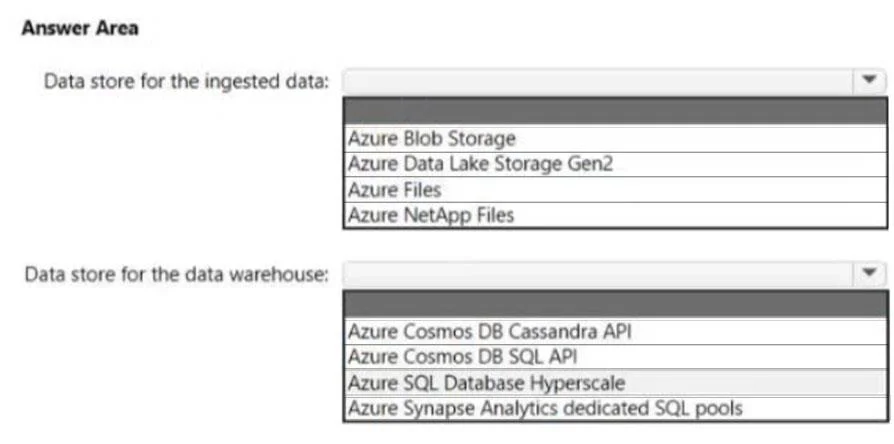
The correct answer is Data store for the ingested data:: Azure Data Lake Storage Gen2; Data store for the data warehouse:: Azure Synapse Analytics dedicated SQL pools. Dropdown 1: Data Store for Ingested Data -> Azure Data Lake Storage Gen2 Why ADLS Gen2 is correct ADLS Gen2 is purpose-built for big data analytics workloads. It combines Azure Blob Storage's scalability with a hierarchical namespace (HNS) that natively supports directory-based…
Question
Exhibit
Answer Area
- Data store for the ingested data:Azure Data Lake Storage Gen2Azure Blob StorageAzure Data Lake Storage Gen2Azure FilesAzure NetApp Files
- Data store for the data warehouse:Azure Synapse Analytics dedicated SQL poolsAzure Cosmos DB Cassandra APIAzure Cosmos DB SQL APIAzure SQL Database HyperscaleAzure Synapse Analytics dedicated SQL pools
Explanation
Dropdown 1: Data Store for Ingested Data -> Azure Data Lake Storage Gen2
Why ADLS Gen2 is correct
ADLS Gen2 is purpose-built for big data analytics workloads. It combines Azure Blob Storage's scalability with a hierarchical namespace (HNS) that natively supports directory-based organization - exactly what "organize data by date and time" requires (e.g., /2026/04/05/14/). It also supports direct querying via tools like Azure Synapse Analytics, Azure Databricks, and HDInsight, satisfying the "queried directly" requirement.
Why the alternatives are wrong
| Option | Why Wrong |
|---|---|
| Azure Blob Storage | Flat namespace - no true directory hierarchy. Pseudo-folders exist but are not first-class, making time-partitioned organization inefficient. Also lacks optimized analytics integration. |
| Azure Files | SMB/NFS file share service. Designed for lift-and-shift of file workloads, not high-volume JSON ingestion or analytics pipelines. |
| Azure NetApp Files | Enterprise NAS service for latency-sensitive workloads (SAP, HPC). Not designed for big data ingestion or analytics at scale. |
Key concept: ADLS Gen2's hierarchical namespace enables Hadoop-compatible directory semantics, making it the standard landing zone for Event Hubs Capture output in analytics architectures.
Dropdown 2: Data Store for the Data Warehouse -> Azure Synapse Analytics dedicated SQL pools
Why Synapse dedicated SQL pools is correct
The requirements specify:
- 50 TB of relational data - dedicated SQL pools scale to petabytes using Massively Parallel Processing (MPP) with distributed storage
- 200-300 concurrent read operations - dedicated pools are designed for high concurrency at scale with workload management and concurrency slots
It also natively reads from ADLS Gen2 (via PolyBase/COPY INTO), closing the loop with Dropdown 1.
Why the alternatives are wrong
| Option | Why Wrong |
|---|---|
| Azure Cosmos DB Cassandra API | NoSQL wide-column store. Not relational, not designed for 50 TB data warehouse workloads or complex analytical SQL queries. |
| Azure Cosmos DB SQL API | NoSQL document store. Optimized for OLTP/operational workloads with single-digit ms latency, not analytical aggregations over 50 TB. |
| Azure SQL Database Hyperscale | Scales storage to 100 TB and supports high reads, but is an OLTP-oriented engine (row-store). It lacks the columnar MPP architecture needed for efficient large-scale analytical queries across 50 TB of warehouse data. |
Key concept: The distinction between OLTP (Azure SQL) and OLAP (Synapse dedicated pools) is critical here. A 50 TB analytical workload with hundreds of concurrent readers is a classic OLAP scenario requiring columnar storage and MPP distribution - the defining characteristics of Synapse dedicated SQL pools.
Topics
Community Discussion
No community discussion yet for this question.