
AZ-305 · Question #154
You have an Azure subscription. You need to deploy an Azure Kubernetes Service (AKS) solution that will use Windows Server 2019 nodes. The solution must meet the following requirements: - Minimize…
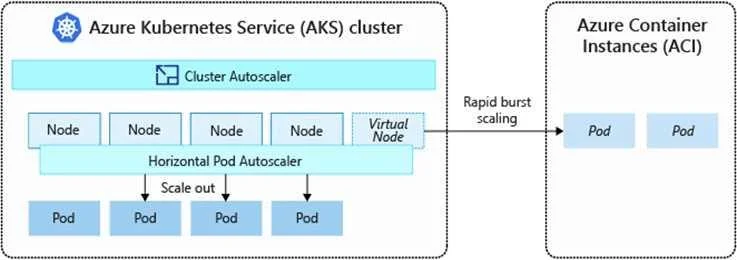
The correct answer is A. cluster autoscaler. Azure Container Instances (ACI) lets you quickly deploy container instances without additional infrastructure overhead. When you connect with AKS, ACI becomes a secured, logical extension of your AKS cluster. The virtual nodes component, which is based on Virtual Kubelet, is…
Question
Exhibit
Options
- Acluster autoscaler
- Bhorizontal pod autoscaler
- CKubernetes version 1.20.2 or newer
- DVirtual nodes with Virtual Kubelet ACI
How the community answered
(22 responses)- A73% (16)
- B18% (4)
- C5% (1)
- D5% (1)
Explanation
Azure Container Instances (ACI) lets you quickly deploy container instances without additional infrastructure overhead. When you connect with AKS, ACI becomes a secured, logical extension of your AKS cluster. The virtual nodes component, which is based on Virtual Kubelet, is installed in your AKS cluster that presents ACI as a virtual Kubernetes node. Kubernetes can then schedule pods that run as ACI instances through virtual nodes, not as pods on VM nodes directly in your AKS cluster. Your application requires no modification to use virtual nodes. Deployments can scale across AKS and ACI and with no delay as cluster autoscaler deploys new nodes in your AKS cluster. Note: AKS clusters can scale in one of two ways: The cluster autoscaler watches for pods that can't be scheduled on nodes because of resource constraints. The cluster then automatically increases the number of nodes. The horizontal pod autoscaler uses the Metrics Server in a Kubernetes cluster to monitor the resource demand of pods. If an application needs more resources, the number of pods is automatically increased to meet the demand. https://docs.microsoft.com/en-us/azure/aks/concepts-scale5
Community Discussion
No community discussion yet for this question.