
AZ-305 · Question #146
Hotspot Questiom A company is looking for a solution that collects a large amount of data from loT devices and performs real time analytics. The data consists of millions of messages that are sent…
The correct answer is Storage solution for historical data: Select your answer; Solution to perform real-time data aggregation: Select your answer. This hotspot question tests knowledge of Azure services for IoT data ingestion, real-time analytics, and storage in native JSON format compatible with Azure Synapse Analytics.
Question
Exhibit
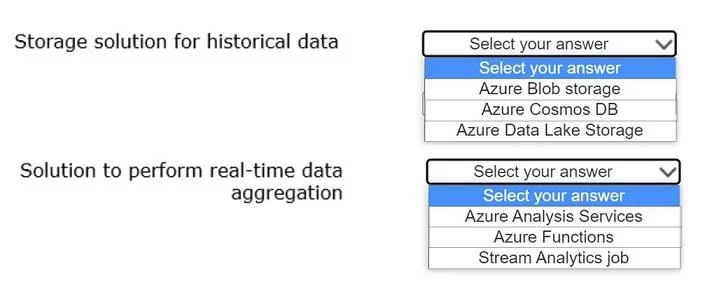
Answer Area
- Storage solution for historical dataSelect your answerSelect your answerAzure Blob storageAzure Cosmos DBAzure Data Lake Storage
- Solution to perform real-time data aggregationSelect your answerSelect your answerAzure Analysis ServicesAzure FunctionsStream Analytics job
Explanation
This hotspot question tests knowledge of Azure services for IoT data ingestion, real-time analytics, and storage in native JSON format compatible with Azure Synapse Analytics.
Approach. For historical data storage in native JSON format that can be moved to Azure Synapse Analytics SQL Pool, Azure Cosmos DB is the correct choice because it natively stores data in JSON format, supports massive scale, and integrates well with Azure Synapse Analytics via Synapse Link. For real-time data aggregation of millions of IoT messages processed hourly and presented on a dashboard, Azure Stream Analytics is the correct choice because it is purpose-built for real-time stream processing, can ingest from IoT Hub or Event Hubs, perform aggregations and windowing functions, connect to reference data (referential data for business information), and output results to dashboards like Power BI or downstream storage. Together, IoT Hub/Event Hubs feeds into Stream Analytics for real-time processing, results are stored in Cosmos DB (JSON format), and then moved to Azure Synapse Analytics for deeper analysis.
Concept tested. The question tests understanding of Azure's IoT and big data analytics stack: specifically, Azure Cosmos DB as a JSON-native, globally distributed database for historical IoT data storage compatible with Synapse Analytics, and Azure Stream Analytics as the real-time aggregation engine that supports reference data joins, windowing functions, and dashboard integration via Power BI output.
Reference. https://docs.microsoft.com/en-us/azure/stream-analytics/stream-analytics-introduction | https://docs.microsoft.com/en-us/azure/cosmos-db/introduction
Topics
Community Discussion
No community discussion yet for this question.