
Microsoft
AZ-104 · Question #217
Case Study 2 - Contoso, Ltd Overview Contoso, Ltd. is a manufacturing company that has offices worldwide. Contoso works with partner organizations to bring products to market. Contoso products are…
The correct answer is [Answer choice] assigned the Owner role for VM1: User1 and User4 are; [Answer choice] can create a virtual machine in RG1: User1 and User4. 1. Users assigned the Owner role for VM1: User1: As the Owner of the entire subscription, User1 automatically has the Owner role for all resources within that subscription, including VM1. User4: Based on the provided correct answer, User4 is assigned the Owner role for VM1…
Submitted by klara.se· Mar 4, 2026Manage Azure identities and governance
Question
Case Study 2 - Contoso, Ltd Overview Contoso, Ltd. is a manufacturing company that has offices worldwide. Contoso works with partner organizations to bring products to market. Contoso products are manufactured by using blueprint files that the company authors and maintains. Existing Environment Currently, Contoso uses multiple types of servers for business operations, including the following: - File servers - Domain controllers - Microsoft SQL Server servers Your network contains an Active Directory forest named contoso.com. All servers and client computers are joined to Active Directory. You have a public-facing application named App1. App1 is comprised of the following three tiers: - A SQL database - A web front end - A processing middle tier Each tier is comprised of five virtual machines. Users access the web front end by using HTTPS only. Requirements Planned Changes Contoso plans to implement the following changes to the infrastructure: - Move all the tiers of App1 to Azure. - Move the existing product blueprint files to Azure Blob storage. - Create a hybrid directory to support an upcoming Microsoft Office 365 migration project. Technical Requirements Contoso must meet the following technical requirements: - Move all the virtual machines for App1 to Azure. - Minimize the number of open ports between the App1 tiers. - Ensure that all the virtual machines for App1 are protected by backups. - Copy the blueprint files to Azure over the Internet. - Ensure that the blueprint files are stored in the archive storage tier. - Ensure that partner access to the blueprint files is secured and temporary. - Prevent user passwords or hashes of passwords from being stored in Azure. - Use unmanaged standard storage for the hard disks of the virtualmachines. - Ensure that when users join devices to Azure Active Directory (Azure AD), the users use a mobile phone to verify their identity. - Minimize administrative effort whenever possible. User Requirements Contoso identifies the following requirements for users: - Ensure that only users who are part of a group named Pilot can join devices to Azure AD. - Designate a new user named Admin1 as the service administrator of the Azure subscription. - Ensure that a new user named User3 can create network objects for the Azure subscription. Hotspot Question You need to configure the Device settings to meet the technical requirements and the user requirements. Which two settings should you modify? To answer, select the appropriate settings in the answer area. Answer:
Exhibit
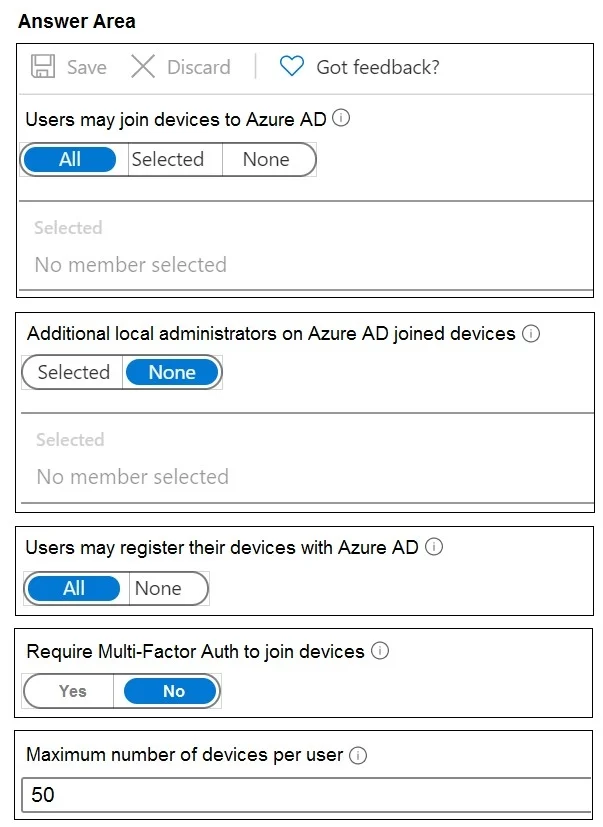
Answer Area
- [Answer choice] assigned the Owner role for VM1User1 and User4 areUser3 isUser1, User3 and User4 areUser1 and User4 areUser1, User3, and User4 areUser1, User2, User3, and User4
- [Answer choice] can create a virtual machine in RG1User1 and User4User1 and User4User1, User2, and User3User1, User2, and User4User1, User3, and User4User1, User2, User3, and User4
Explanation
- Users assigned the Owner role for VM1:
- User1: As the Owner of the entire subscription, User1 automatically has the Owner role for all resources within that subscription, including VM1.
- User4: Based on the provided correct answer, User4 is assigned the Owner role for VM1. (The detailed explanation on the page describes User4 as a Contributor of RG1, but the verified answer takes precedence here for VM1 ownership).
- Users who can create a virtual machine in RG1:
- User1: As the subscription Owner, User1 has permissions to create any resource, including virtual machines, in any resource group like RG1.
- User4: User4 is explicitly described as a Contributor of RG1. The Contributor role grants the ability to manage everything within the resource group, which includes creating virtual machines.
Topics
#Azure AD Device Join#Conditional Access Policy#Multi-factor Authentication#Device Restrictions
Community Discussion
No community discussion yet for this question.