
AD0-E605 · Question #86
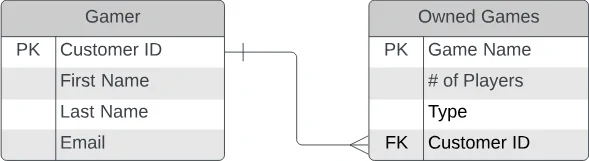
A relational diagram can be seen in the exhibit; a Gamer (parent entity) is shown to have many Owned Games (child entity). Each owned game is essentially a property of the gamer. Looking at this…
The correct answer is B. Acts as an object array. In a one-to-many relationship, the Gamer parent can be associated with multiple Owned Games rows, each of which is a structured record with its own attributes (e.g., game title, purchase date). From a data architect's perspective - especially when thinking in terms of…
Question
A relational diagram can be seen in the exhibit; a Gamer (parent entity) is shown to have many Owned Games (child entity). Each owned game is essentially a property of the gamer. Looking at this diagram, what would a data architect say about how the Owned Games table will act within the parent entity?
Exhibit
Options
- AActs as an object
- BActs as an object array
- CActs as a new schema
- DActs as an array of values
How the community answered
(35 responses)- A14% (5)
- B77% (27)
- C6% (2)
- D3% (1)
Explanation
In a one-to-many relationship, the Gamer parent can be associated with multiple Owned Games rows, each of which is a structured record with its own attributes (e.g., game title, purchase date). From a data architect's perspective - especially when thinking in terms of object-relational or document models - that collection of structured child records maps directly to an object array: an array where each element is an object, not a primitive.
Why the distractors fail:
- A (object): A single object implies one-to-one. Here the relationship is one-to-many, so a single object is insufficient.
- C (new schema): A child table lives in the same schema; it doesn't create a new one. A new schema would be an entirely separate namespace.
- D (array of values): An array of values holds scalar/primitive data (e.g.,
[1, 2, 3]). Owned Games has its own columns/attributes, making each entry an object, not a plain value.
Memory tip: Picture the JSON equivalent - a Gamer would have "ownedGames": [{...}, {...}, {...}]. That bracket-of-braces structure is exactly an object array. If each entry has properties, it's an object; if there are many of them, it's an array - hence object array.
Topics
Community Discussion
No community discussion yet for this question.