
AD0-E605 · Question #13
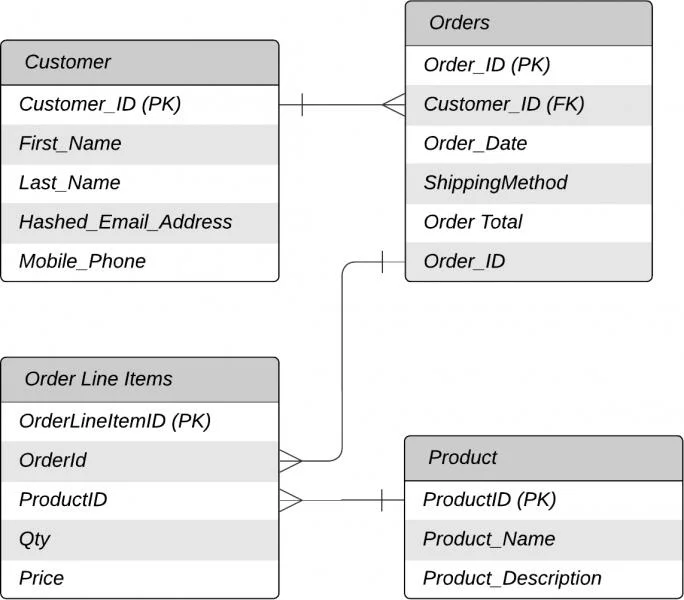
An architect is tasked with onboarding e-commerce data into Adobe Experience Platform (AEP). An ERD of the data is shown below. What are the three correct mappings of source entities into AEP…
The correct answer is B. Create Orders as Experience Event C. Embed Order Line Items as an object array in orders D. Create Product as a Custom Class. Orders map to Experience Event (B) because a purchase is a discrete, timestamped action - exactly what the XDM ExperienceEvent class is designed for. Order Line Items embed as an object array within Orders (C) because they are subordinate, dependent records with no independent…
Question
An architect is tasked with onboarding e-commerce data into Adobe Experience Platform (AEP). An ERD of the data is shown below. What are the three correct mappings of source entities into AEP classes? (Choose three.)
Exhibit
Options
- ACreate Product and Order Line Items as custom classes
- BCreate Orders as Experience Event
- CEmbed Order Line Items as an object array in orders
- DCreate Product as a Custom Class
- ECreate Order Line Items as Experience Event
How the community answered
(28 responses)- A11% (3)
- B82% (23)
- E7% (2)
Explanation
Orders map to Experience Event (B) because a purchase is a discrete, timestamped action - exactly what the XDM ExperienceEvent class is designed for. Order Line Items embed as an object array within Orders (C) because they are subordinate, dependent records with no independent identity or need for separate querying; embedding them keeps the event record self-contained. Products map to a Custom Class (D) because product catalog data is reference/lookup data - not a time-series event and not a person profile - so it requires its own custom XDM class.
Option A is wrong because it incorrectly promotes Order Line Items to a standalone custom class - they don't exist independently of an Order, so embedding them is the correct pattern. Option E is wrong because Order Line Items are not discrete events themselves; they are constituent parts of an Order event and lack their own timestamp or identity as standalone occurrences.
Memory tip: Use the "Who, What, When" rule - Who bought something → Individual Profile; When did they buy it → Experience Event (Orders); What did they buy → Custom Class (Products); and how many/which items → array inside the event (Line Items).
Topics
Community Discussion
No community discussion yet for this question.