
72201T · Question #71
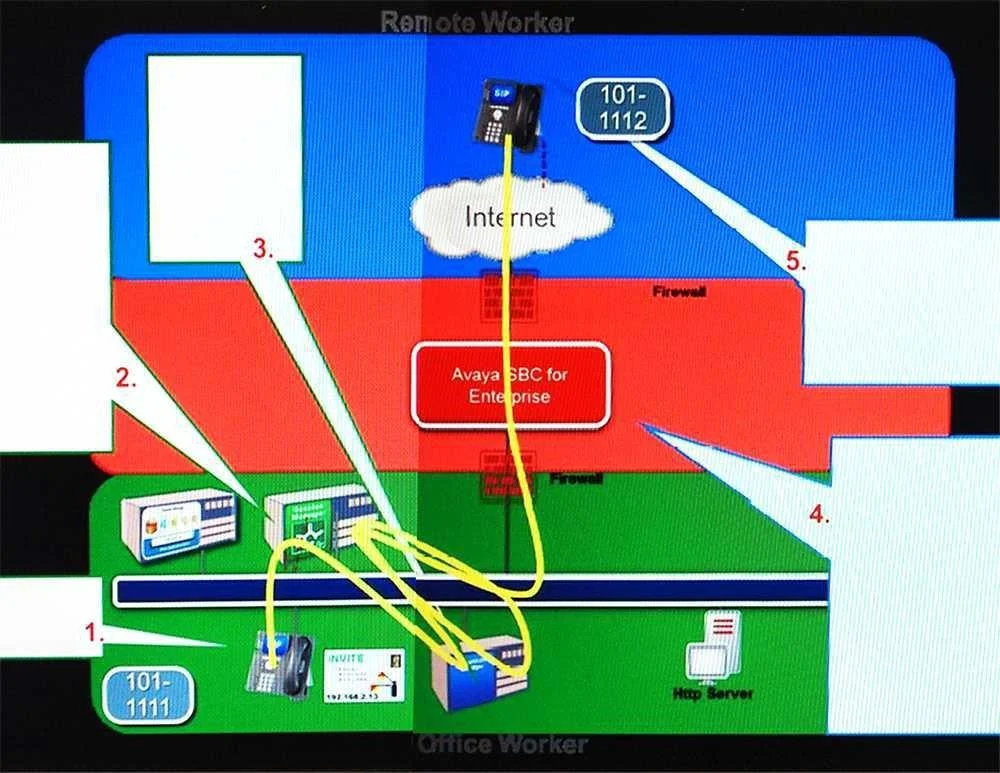
Refer to the Exhibit. Which two statements about a call from AST 1011111 to Remote Worker AST 1011112 are true? (Choose two.)
The correct answer is C. As far as Avaya Aura® Session Manager (SM) is concerned, all Remote Worker phones are E. The configuration of a Remote Worker AST is the same as an Office Worker AST in the Avaya. C is correct because Session Manager processes SIP registrations and call routing without distinguishing between office workers and remote workers - from SM's perspective, both appear as standard SIP endpoints. The SBCE transparently handles the network boundary, so SM's logic…
Question
Refer to the Exhibit. Which two statements about a call from AST 1011111 to Remote Worker AST 1011112 are true? (Choose two.)
Exhibit
Options
- AAvaya Session Border Controller for Enterprise (SBCE) periodically sends SIP Options to
- BSIP Signaling traverses the Avaya Session Border Controller for Enterprise (SBCE) and the
- CAs far as Avaya Aura® Session Manager (SM) is concerned, all Remote Worker phones are
- DAvaya Session Border Controller for Enterprise (SBCE) needs to be built as a trusted SIP Entity
- EThe configuration of a Remote Worker AST is the same as an Office Worker AST in the Avaya
How the community answered
(50 responses)- A14% (7)
- B4% (2)
- C76% (38)
- D6% (3)
Explanation
C is correct because Session Manager processes SIP registrations and call routing without distinguishing between office workers and remote workers - from SM's perspective, both appear as standard SIP endpoints. The SBCE transparently handles the network boundary, so SM's logic and routing rules apply identically to all registered ASTs regardless of location.
E is correct because the AST endpoint configuration in Avaya Aura (Communication Manager/System Manager) is identical for remote and office workers. Remote worker capability is delivered by the SBCE and supporting infrastructure (DNS, routing), not by any special flag or field in the AST station configuration itself.
Why the distractors are wrong: A describes SIP OPTIONS monitoring, which relates to trunk/entity health checking - not a defining behavior of an AST-to-remote-worker call flow. B incorrectly implies SIP signaling traverses the SBCE for both endpoints; the office worker's signaling goes directly to SM, while only the remote worker's leg uses the SBCE. D is the trickiest distractor - while the SBCE is indeed configured as a trusted SIP entity in a real deployment, the question focuses on what is definitionally true about the call behavior, and the two most universally accurate statements are C and E.
Memory tip: Think of the SBCE as a "location-transparent firewall" - it hides the remote worker's true position from SM and CM, making everything look local. If SM and CM can't tell them apart, neither the routing logic nor the endpoint configuration needs to differ.
Topics
Community Discussion
No community discussion yet for this question.