
72201T · Question #67
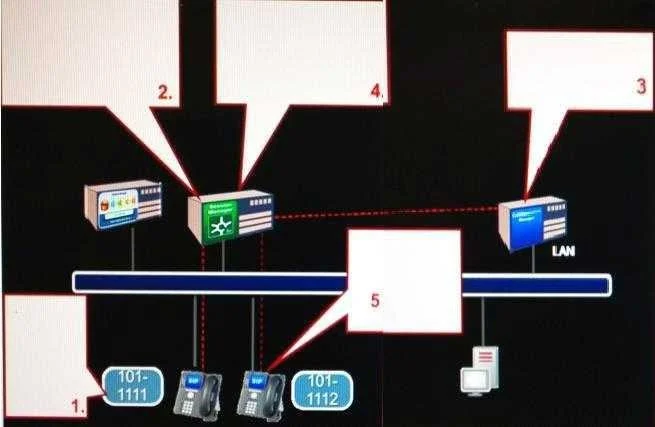
Refer to the Exhibit. Which two statements are true about a call from AST 1011111 to AST 1011112? (Choose two.)
The correct answer is B. In step 2, Avaya Aura® Session Manager (SM) matches 1011111 with a Communication Profile, C. In step 1, when 1011111 draws dial tone it sends an Invite to Avaya Aura® Session Manager. Options B and C are correct because they accurately describe the SIP call flow in an Avaya Aura environment. In step 1, an AST (Avaya SIP Telephone) like 1011111 initiates a call by sending a SIP INVITE directly to Session Manager - this is how all SIP endpoints begin calls in…
Question
Refer to the Exhibit. Which two statements are true about a call from AST 1011111 to AST 1011112? (Choose two.)
Exhibit
Options
- AIn step 3, Avaya Aura® Communication Manager (CM) sends SIP Options to 1011112 looking for
- BIn step 2, Avaya Aura® Session Manager (SM) matches 1011111 with a Communication Profile,
- CIn step 1, when 1011111 draws dial tone it sends an Invite to Avaya Aura® Session Manager
- DIn step 2, the Avaya Aura® Session Manager (SM) uses a dial pattern and routing policy to route
How the community answered
(26 responses)- A4% (1)
- B88% (23)
- D8% (2)
Explanation
Options B and C are correct because they accurately describe the SIP call flow in an Avaya Aura environment. In step 1, an AST (Avaya SIP Telephone) like 1011111 initiates a call by sending a SIP INVITE directly to Session Manager - this is how all SIP endpoints begin calls in the Aura architecture, making C correct. In step 2, Session Manager's first action upon receiving that INVITE is to identify the calling party by matching 1011111 against a Communication Profile, which governs that user's features and permissions, making B correct.
Option A is wrong because Communication Manager does not send SIP OPTIONS to reach a destination - OPTIONS is a keep-alive/capability-query message, not a call-setup message. CM would send an INVITE to reach 1011112, not an OPTIONS.
Option D is wrong because dial pattern matching and routing policy application describe what SM does to determine where to route the call - this is a separate processing step from (and occurs after) the Communication Profile matching described in step 2.
Memory tip: Think of the flow as Who is calling? → Where are they going? → Connect them. Step 2 answers "Who is calling?" (Communication Profile match), while routing policies answer "Where are they going?" - these are sequential, not simultaneous steps in Session Manager processing.
Topics
Community Discussion
No community discussion yet for this question.