
70-663 · Question #148
Your network contains a perimeter network and an internal network. You are designing an Exchange organization for a company named Contoso, Ltd. All servers in the organization will have Exchange…
The correct answer is A. Deploy Edge Transport servers on the perimeter network Deploy Hub Transport servers on. For the recipient filtering in the Edge Transport Server to take place, the server needs to know which recipients exist in the internal Exchange environment. The Edge Transport Server also needs to have knowledge about the existing Hub Transport Server in the internal Exchange…
Question
Your network contains a perimeter network and an internal network. You are designing an Exchange organization for a company named Contoso, Ltd. All servers in the organization will have Exchange Server 2010 Service Pack 1 (SP1) installed. Contoso plans to use a third-party message hygiene solution on the Internet to relay all inbound SMTP e-mail to the Exchange servers. You need to recommend an inbound SMTP e-mail deployment solution for the Exchange organization. The solution must ensure that all Exchange servers can be managed by using Group Policies. Which of the following solutions is the best recommendation? (More than one answer choice may achieve the goal. Select the BEST answer.)
Exhibit
Options
- ADeploy Edge Transport servers on the perimeter network Deploy Hub Transport servers on
- BDeploy Edge Transport servers and Hub Transport servers on the internal network
- CDeploy a reverse proxy server on the perimeter network
- DDeploy a reverse proxy server, Edge Transport servers, and Hub Transport servers on the
How the community answered
(35 responses)- A83% (29)
- B3% (1)
- C9% (3)
- D6% (2)
Explanation
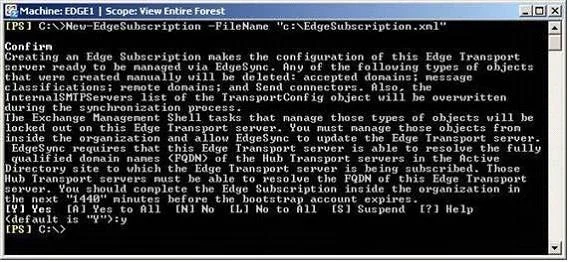
For the recipient filtering in the Edge Transport Server to take place, the server needs to know which recipients exist in the internal Exchange environment. The Edge Transport Server also needs to have knowledge about the existing Hub Transport Server in the internal Exchange organization, where the Edge Transport Server has to deliver its SMTP messages to. This information is pushed from an internal Hub Transport Server to the Edge Transport Server by a process called Edgesync. Please note that for a successful synchronization from the Hub Transport Server to the Edge Transport Server, you have to open port 50636 on the internal firewall. This port has to be opened from the internal network to the DMZ and not vice versa. To setup an Edge Synchronization, a special XML file has to be created on the Edge Transport Server. This XML file has to be imported to a Hub Transport Server on the internal network creating a relationship between the Edge Transport Server and the respective Hub Transport Server. Once that relationship is created, the Edgesync service can be started. Copy the <<filename.xml>> to a directory on the Hub Transport Server and execute these To test synchronization status: You can open the EMC on the Edge Transport server and take a look at the Accepted Domains tab and Send Connectors tab. This also indicates the synchronization succeeded.
Topics
Community Discussion
No community discussion yet for this question.