
400-007 · Question #446
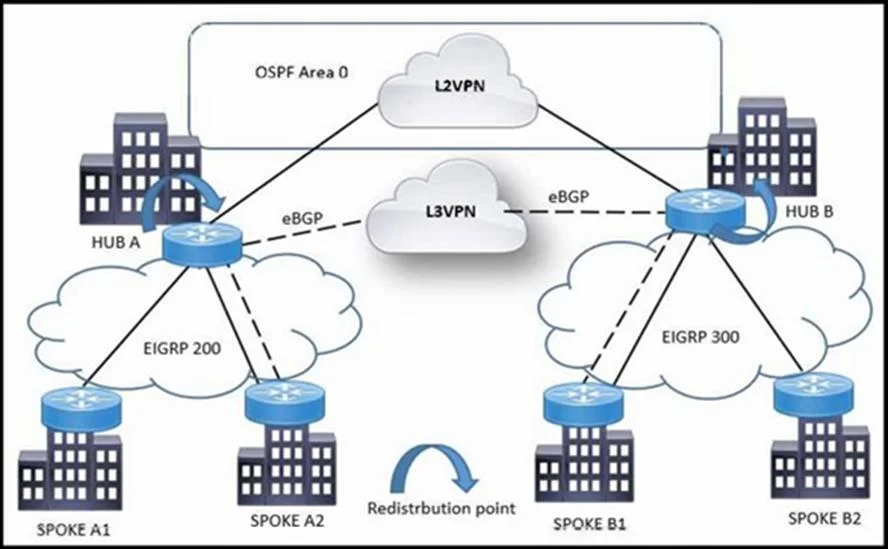
Refer to the exhibit. A customer network design team is planning a migration from a legacy TDM- based L2VPN to an MPLS-based L3VPN. Migration is planned in a phased approach: - OSPF backbone Link…
The correct answer is C. Enable route-filtering on OSPF backbone routers for spoke traffic. Filtering spoke prefixes on the temporary OSPF backbone between HUB A and HUB B prevents those routes from circulating simultaneously via OSPF and the new eBGP/L3VPN path, removing dual-path feedback and avoiding routing loops during the phased migration.
Question
Refer to the exhibit. A customer network design team is planning a migration from a legacy TDM- based L2VPN to an MPLS-based L3VPN. Migration is planned in a phased approach:
- OSPF backbone Link between HUB A and HUB B sites to be migrated to
eBGP.
- Spoke A2 and Spoke B1 will be migrated to the L3VPN.
Which solution design can be considered to avoid routing loops during backbone link migration?
Exhibit
Options
- ARedistribute EIGRP 200 and 300 with low cost into BGP.
- BOSPF backbone area advertises summarized routes to hub.
- CEnable route-filtering on OSPF backbone routers for spoke traffic.
- DAdvertise low AD value for transit traffic on hub sites.
How the community answered
(37 responses)- A5% (2)
- B22% (8)
- C62% (23)
- D11% (4)
Explanation
Filtering spoke prefixes on the temporary OSPF backbone between HUB A and HUB B prevents those routes from circulating simultaneously via OSPF and the new eBGP/L3VPN path, removing dual-path feedback and avoiding routing loops during the phased migration.
Topics
Community Discussion
No community discussion yet for this question.