
400-007 · Question #437
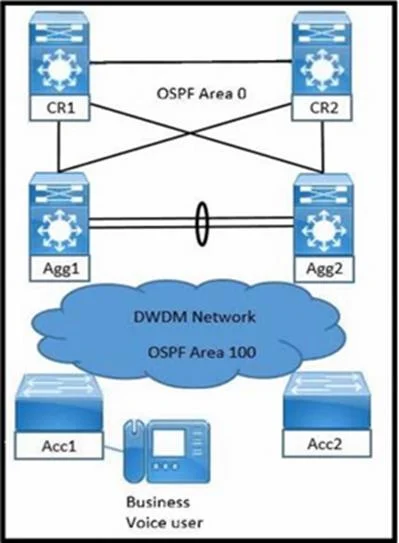
Refer to the exhibit. A solution architect is tasked with designing a quick fault detection and convergence solution based on a set of requirements: - Due to the use of voice applications, users…
The correct answer is A. Make OSPF peers use BFD and set the BFD timers to an appropriate value. Bidirectional Forwarding Detection (BFD) provides sub-second failure detection independent of OSPF hello/dead timers; integrating BFD with OSPF area 100 and setting aggressive BFD timers enables <100 ms fault detection and rapid path switchover.
Question
Refer to the exhibit. A solution architect is tasked with designing a quick fault detection and convergence solution based on a set of requirements:
- Due to the use of voice applications, users must ideally not
experience traffic disruption in excess of 100 milliseconds in case of link or node failures in OSPF area 100.
- The enterprise requires the network to be highly available.
- Traffic must quickly switch to another path without waiting for the
OSPF dead interval to kick in. What can be included in the design in order to meet these requirements?
Exhibit
Options
- AMake OSPF peers use BFD and set the BFD timers to an appropriate value.
- BEnable IP SLA tracking with next hop to OSPF peer.
- CUse fault propagation timers specified in milliseconds for the OSPF SPF algorithm.
- DAdjust SPF delay and LSA interval timers in OSPF protocol.
How the community answered
(26 responses)- A58% (15)
- B12% (3)
- C23% (6)
- D8% (2)
Explanation
Bidirectional Forwarding Detection (BFD) provides sub-second failure detection independent of OSPF hello/dead timers; integrating BFD with OSPF area 100 and setting aggressive BFD timers enables <100 ms fault detection and rapid path switchover.
Topics
Community Discussion
No community discussion yet for this question.