
400-007 · Question #371
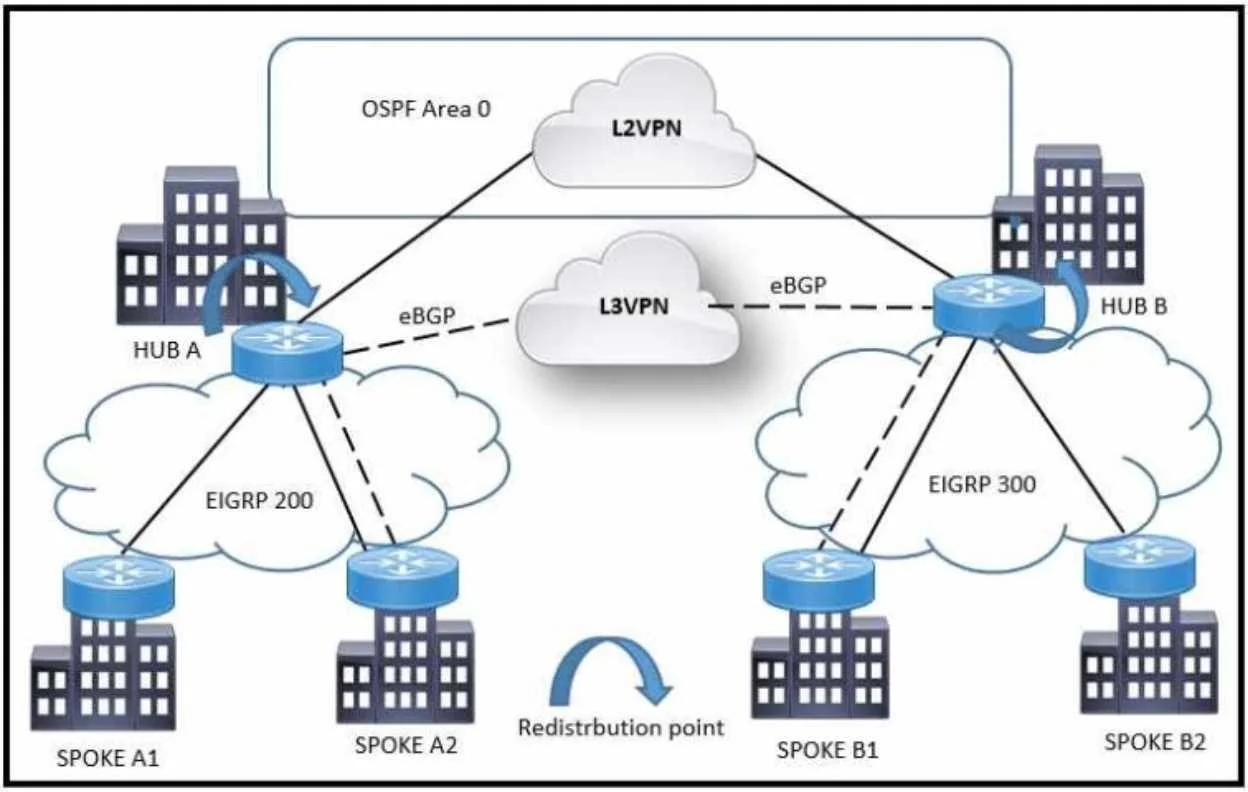
Refer to the exhibit A customer network design team is planning a migration from a legacy TDM- based L2VPN to an MPLS-based L3VPN Migration is planned in a phased approach: - OSPF backbone Link…
The correct answer is C. OSPF backbone area advertises summarized routes to hub. During a phased OSPF-to-eBGP backbone migration, advertising summarized routes from the OSPF backbone area to the hub sites prevents routing loops by limiting route redistribution granularity between the two coexisting protocols.
Question
Refer to the exhibit A customer network design team is planning a migration from a legacy TDM- based L2VPN to an MPLS-based L3VPN Migration is planned in a phased approach:
- OSPF backbone Link between HUB A and HUB B sites to be migrated to
eBGP
- Spoke A2 and Spoke B1 will be migrated to the L3VPN
Which solution design can be considered to avoid routing loops during backbone link migration?
Exhibit
Options
- AEnable route-filtering on OSPF backbone routers for spoke traffic
- BAdvertise low AD value for transit traffic on hub sites.
- COSPF backbone area advertises summarized routes to hub.
- DRedistribute EIGRP 200 and 300 with low cost into BGP
How the community answered
(15 responses)- A7% (1)
- B20% (3)
- C67% (10)
- D7% (1)
Why each option
During a phased OSPF-to-eBGP backbone migration, advertising summarized routes from the OSPF backbone area to the hub sites prevents routing loops by limiting route redistribution granularity between the two coexisting protocols.
Applying route filtering on OSPF backbone routers treats individual symptoms rather than systematically eliminating the redistribution conditions that cause loops during dual-protocol migration.
Advertising a low administrative distance for transit traffic makes OSPF routes more preferred than BGP routes, causing suboptimal path selection rather than preventing routing loops.
When OSPF and eBGP coexist during the transition, the hub sites risk learning specific spoke routes via BGP and then redistributing them back into OSPF, which re-advertises them into BGP and creates a loop; summarizing OSPF backbone routes to the hub removes the more-specific routes that would otherwise cycle between protocols.
Redistributing EIGRP 200 and 300 into BGP is irrelevant because the scenario involves an OSPF backbone being migrated to eBGP, with no EIGRP in the described topology.
Concept tested: Routing loop prevention during OSPF to eBGP backbone migration
Source: https://www.cisco.com/c/en/us/support/docs/ip/border-gateway-protocol-bgp/26634-bgp-toc.html
Topics
Community Discussion
No community discussion yet for this question.