
400-007 · Question #335
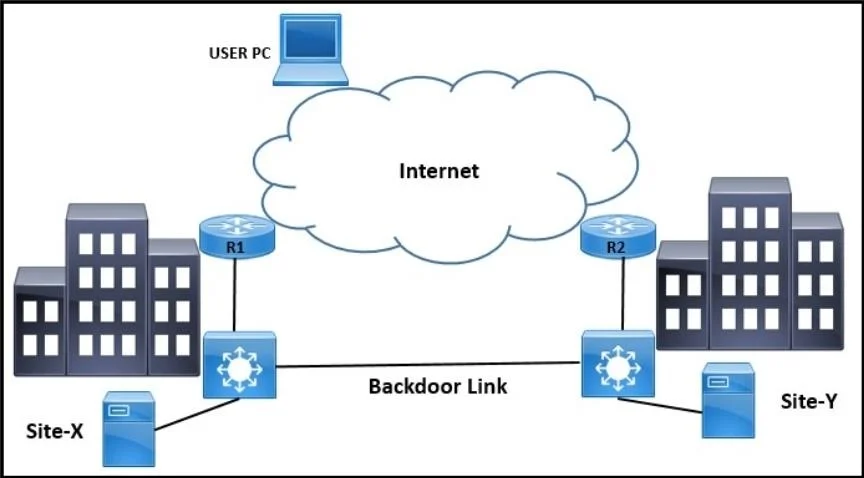
Refer to the exhibit. Two data center sites, X and Y, are connected with a direct backdoor link under these conditions: - Site-specific firewalls are deployed behind the Internet edge routers R1 and…
The correct answer is C. Establish control plane peering between edge routers. When two sites advertise the same prefix and return traffic arrives at the wrong site, establishing BGP control plane peering between edge routers enables coordinated routing policy to correct asymmetric traffic flow.
Question
Refer to the exhibit. Two data center sites, X and Y, are connected with a direct backdoor link under these conditions:
- Site-specific firewalls are deployed behind the Internet edge routers
R1 and R2.
- Both sites are advertising the address pool 100.75.10.0/23 toward the
Internet. Site-X finds that Internet traffic returning from user PCs comes back on the Site-Y link. Which design resolves the issue?
Exhibit
Options
- AAdd a static route toward the Internet on Site-X.
- BChange the Site-Y firewall configuration to replicate the Site-X configuration.
- CEstablish control plane peering between edge routers.
- DUse BGP MED to influence Site-X return traffic.
How the community answered
(36 responses)- A8% (3)
- B6% (2)
- C69% (25)
- D17% (6)
Why each option
When two sites advertise the same prefix and return traffic arrives at the wrong site, establishing BGP control plane peering between edge routers enables coordinated routing policy to correct asymmetric traffic flow.
A static route toward the Internet on Site-X affects only outbound traffic originating at Site-X and has no influence on how external Internet routers return traffic to the shared 100.75.10.0/23 prefix.
Replicating Site-X's firewall configuration on Site-Y normalizes security policy but does not alter the BGP routing decisions made by upstream Internet routers that cause asymmetric return traffic.
Establishing control plane peering (BGP) between R1 at Site-X and R2 at Site-Y over the backdoor link allows the routers to exchange routing and reachability information. With this peering in place, both edge routers can coordinate BGP attributes such as AS-path prepending or local preference to ensure Internet return traffic is directed back to the originating site. Without this peering, each site operates independently and cannot signal routing preferences to influence inbound traffic symmetrically.
BGP MED can influence inbound traffic from directly connected BGP peers, but it requires an established BGP peering session to advertise MED values, making control plane peering a prerequisite before MED can be applied.
Concept tested: BGP control plane peering for symmetric traffic engineering
Source: https://www.cisco.com/c/en/us/support/docs/ip/border-gateway-protocol-bgp/26634-bgp-toc.html
Topics
Community Discussion
No community discussion yet for this question.