
400-007 · Question #31
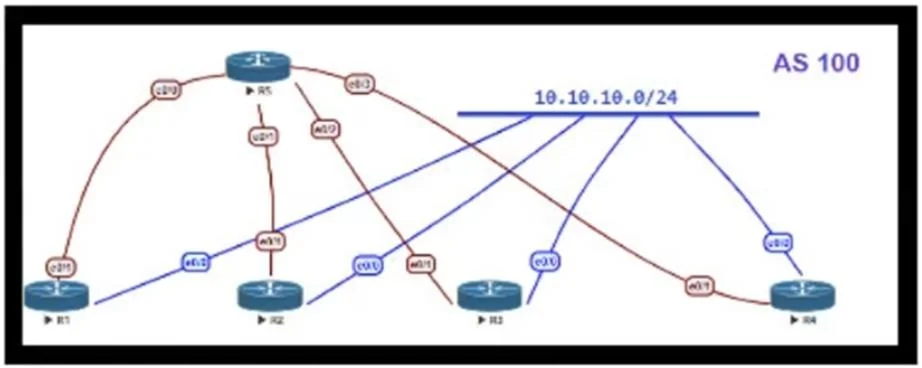
Refer to the exhibit. OSPF is running as the IGP to provide reachability to all AS100 networks. R3 and R4 are the current ABRs at the boundary of OSPF Area0 and Area1. Now BGP must be deployed…
The correct answer is A. R5 should be configured as a route reflector for R1, R2, R3 and R4. BGP routes must be. Using R5 as an iBGP route reflector eliminates the full-mesh requirement within AS100, allowing Internet routes received at R1 and R2 to be reflected efficiently to all internal BGP peers.
Question
Refer to the exhibit. OSPF is running as the IGP to provide reachability to all AS100 networks. R3 and R4 are the current ABRs at the boundary of OSPF Area0 and Area1. Now BGP must be deployed within AS100 because it will be receiving Internet routes from its eBGP peers (the service provider) connected to R1 and R2. What is an optimal solution for this deployment to configure BGP relationships and redistribute BGP learned routes into OSPF?
Exhibit
Options
- AR5 should be configured as a route reflector for R1, R2, R3 and R4. BGP routes must be
- BConfiguration should be set up with R1 and R2, and R3 in one sub AS, with and R4 in another,
- CA full mesh should be deployed between all the routers with mutual redistribution to take place at
- DR1, R2, R3 and R4 must be set up with a neighbor relationship with R5 only must not be a route
How the community answered
(36 responses)- A56% (20)
- B25% (9)
- C14% (5)
- D6% (2)
Why each option
Using R5 as an iBGP route reflector eliminates the full-mesh requirement within AS100, allowing Internet routes received at R1 and R2 to be reflected efficiently to all internal BGP peers.
A route reflector removes the iBGP full-mesh requirement (which would need n*(n-1)/2 sessions for five routers) by allowing R5 to reflect iBGP-learned routes to all clients R1, R2, R3, and R4; R1 and R2 receive Internet routes via eBGP from the service provider and advertise them into iBGP, and redistribution into OSPF is optimally performed only at ABRs R3 and R4, confining BGP-to-IGP redistribution to the boundary routers.
BGP confederations split the AS into sub-ASes to reduce iBGP mesh complexity, but they add significant configuration overhead and are not the optimal solution when a single route reflector achieves the same scalability goal with far less complexity.
A full iBGP mesh with mutual redistribution at every router creates redundant redistribution points, risks routing loops through suboptimal path selection, and does not scale - it is the opposite of an optimal design.
Configuring R1-R4 to peer only with R5 without designating R5 as a route reflector still violates the iBGP split-horizon rule, meaning R5 could not forward iBGP-learned routes between its peers without the route reflector role explicitly configured.
Concept tested: iBGP route reflector design for scalable internal AS routing
Source: https://www.cisco.com/c/en/us/td/docs/ios-xml/ios/iproute_bgp/configuration/xe-16/irg-xe-16-book/irg-route-reflectors.html
Topics
Community Discussion
No community discussion yet for this question.