
400-007 · Question #280
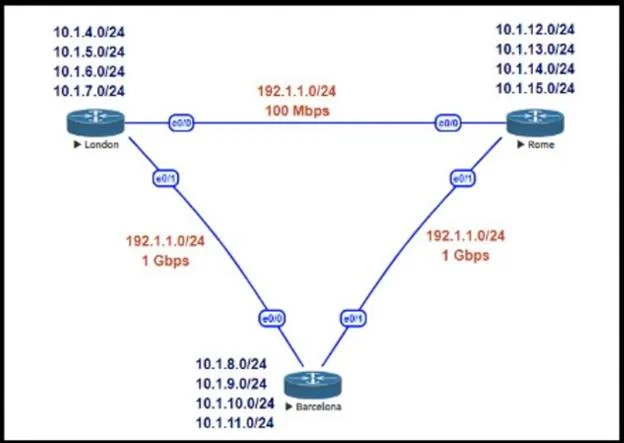
Refer to the exhibit. This network is running OSPF as the routing protocol. The internal networks are being advertised in OSPF London and Rome are using the direct link to reach each other although…
The correct answer is B. Change the OSPF reference bandwidth to accommodate faster links. OSPF's default reference bandwidth of 100 Mbps causes all links at or above 100 Mbps to receive an identical cost of 1, preventing proper path selection when faster alternate paths exist.
Question
Refer to the exhibit. This network is running OSPF as the routing protocol. The internal networks are being advertised in OSPF London and Rome are using the direct link to reach each other although the transfer rates are better via Barcelona. Which OSPF design change allows OSPF to calculate the proper costs?
Exhibit
Options
- AImplement OSPF summarization to fix the issue
- BChange the OSPF reference bandwidth to accommodate faster links
- CFilter the routes on the link between London and Rome
- DChange the interface bandwidth on all the links
How the community answered
(25 responses)- A20% (5)
- B64% (16)
- C8% (2)
- D8% (2)
Why each option
OSPF's default reference bandwidth of 100 Mbps causes all links at or above 100 Mbps to receive an identical cost of 1, preventing proper path selection when faster alternate paths exist.
OSPF summarization reduces routing table size by aggregating prefixes but has no effect on individual link cost calculations or the path OSPF selects between two specific endpoints.
OSPF calculates interface cost as reference bandwidth divided by interface bandwidth; with the default 100 Mbps reference bandwidth, both a 100 Mbps direct London-Rome link and a faster multi-gigabit path via Barcelona receive a cost of 1, making them appear equal. Increasing the reference bandwidth using 'auto-cost reference-bandwidth' allows OSPF to assign proportionally lower costs to faster links, enabling correct path preference toward Barcelona.
Filtering routes on the London-Rome link would remove that path from the OSPF topology entirely rather than enabling cost-based comparison, which forces traffic via Barcelona but does not fix the underlying cost calculation problem.
Adjusting individual interface bandwidth values is a per-interface workaround that does not address the root cause; changing the global OSPF reference bandwidth is the correct design-level fix that scales uniformly across all interfaces.
Concept tested: OSPF reference bandwidth and link cost calculation
Source: https://www.cisco.com/c/en/us/support/docs/ip/open-shortest-path-first-ospf/7039-1.html
Topics
Community Discussion
No community discussion yet for this question.