
400-007 · Question #254
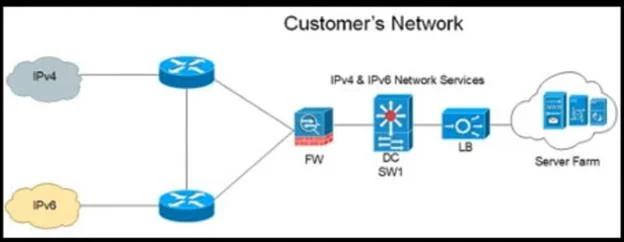
Refer to the exhibit. Company XYZ is currently running IPv4 but has decided to start the transition into IPv6. The initial objective is to allow communication based on IPv6 wherever possible and…
The correct answer is C. dual stack. Dual stack allows network devices to run both IPv4 and IPv6 simultaneously, enabling IPv6 wherever possible while maintaining backward compatibility for IPv4-only devices.
Question
Refer to the exhibit. Company XYZ is currently running IPv4 but has decided to start the transition into IPv6. The initial objective is to allow communication based on IPv6 wherever possible and there should still be support in place for devices that only support IPv4. These devices must be able to communicate to IPv6 devices as well. Which solution must be part of the design?
Exhibit
Options
- Aaddress family translation
- Bhost-to-host tunneling
- Cdual stack
- D6rd tunneling
How the community answered
(30 responses)- A17% (5)
- B3% (1)
- C73% (22)
- D7% (2)
Why each option
Dual stack allows network devices to run both IPv4 and IPv6 simultaneously, enabling IPv6 wherever possible while maintaining backward compatibility for IPv4-only devices.
Address family translation such as NAT64/DNS64 converts traffic between IPv4 and IPv6 at a network boundary but does not enable native IPv6 communication throughout the infrastructure or serve as the primary transition strategy.
Host-to-host tunneling encapsulates IPv6 packets inside IPv4 for transport across IPv4-only segments but does not natively enable IPv6 communication wherever possible across the broader network.
Dual stack is the foundational IPv6 transition mechanism that configures devices to operate both IPv4 and IPv6 concurrently, directly satisfying the requirement to use IPv6 wherever possible. It also preserves full IPv4 support so legacy IPv4-only devices retain connectivity across the existing infrastructure. Without dual stack as part of the design, a phased migration cannot accommodate both IPv4-only devices and IPv6-capable devices simultaneously.
6rd tunneling is designed to rapidly deploy IPv6 over an existing IPv4 ISP infrastructure using encapsulation but does not provide the native dual-protocol support required for IPv4-only devices to interoperate with IPv6 devices.
Concept tested: IPv6 transition mechanisms and dual stack deployment
Source: https://www.cisco.com/c/en/us/support/docs/ip/ip-version-6-ipv6/113993-ipv6-migration-strategies.html
Topics
Community Discussion
No community discussion yet for this question.