
400-007 · Question #17
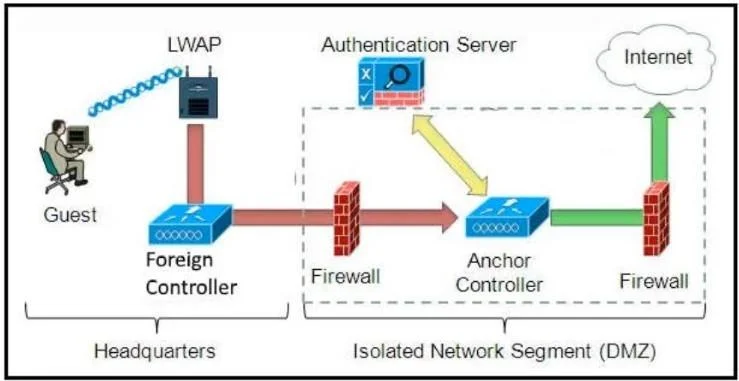
Refer to the diagram. Which solution must be used to send traffic from the foreign wireless LAN controller to the anchor wireless LAN controller?
The correct answer is C. Encapsulate packets into an EoIP tunnel and send them to the anchor controller. In Cisco WLC mobility anchoring, the foreign controller tunnels client traffic to the anchor controller using an EoIP (Ethernet over IP) tunnel, preserving Layer 2 client context across routed boundaries.
Question
Refer to the diagram. Which solution must be used to send traffic from the foreign wireless LAN controller to the anchor wireless LAN controller?
Exhibit
Options
- ASend packets from the foreign controller to the anchor controller via Layer 3 MPLS VPN or VRF-
- BSend packets without encapsulation to the anchor controller over the routed network.
- CEncapsulate packets into an EoIP tunnel and send them to the anchor controller.
- DSend packets from the foreign controller to the anchor controller via IPinIP or IPsec tunnel.
How the community answered
(19 responses)- A5% (1)
- B16% (3)
- C74% (14)
- D5% (1)
Why each option
In Cisco WLC mobility anchoring, the foreign controller tunnels client traffic to the anchor controller using an EoIP (Ethernet over IP) tunnel, preserving Layer 2 client context across routed boundaries.
MPLS VPN or VRF is a routing/segmentation technology and is not the encapsulation method used between WLC peers in the mobility anchor architecture.
Sending packets without encapsulation would not preserve the client's Layer 2 identity across a routed network, breaking the mobility anchor functionality.
Cisco WLC mobility anchoring specifically uses EoIP (Ethernet over IP) tunnels to carry client traffic between foreign and anchor controllers. This encapsulation preserves the original Ethernet frame, allowing the anchor controller to apply policy and provide the client with its home VLAN/subnet even when roaming to a foreign site. EoIP is the defined inter-controller tunneling mechanism in Cisco's mobility architecture.
IPinIP or IPsec are valid inter-site tunneling protocols in general networking, but Cisco WLC mobility specifically requires EoIP encapsulation, not these protocols, for controller-to-controller client traffic.
Concept tested: Cisco WLC mobility anchor EoIP tunneling
Source: https://www.cisco.com/c/en/us/support/docs/wireless/4400-series-wireless-lan-controllers/107606-anchor-config-guide.html
Topics
Community Discussion
No community discussion yet for this question.