
400-007 · Question #154
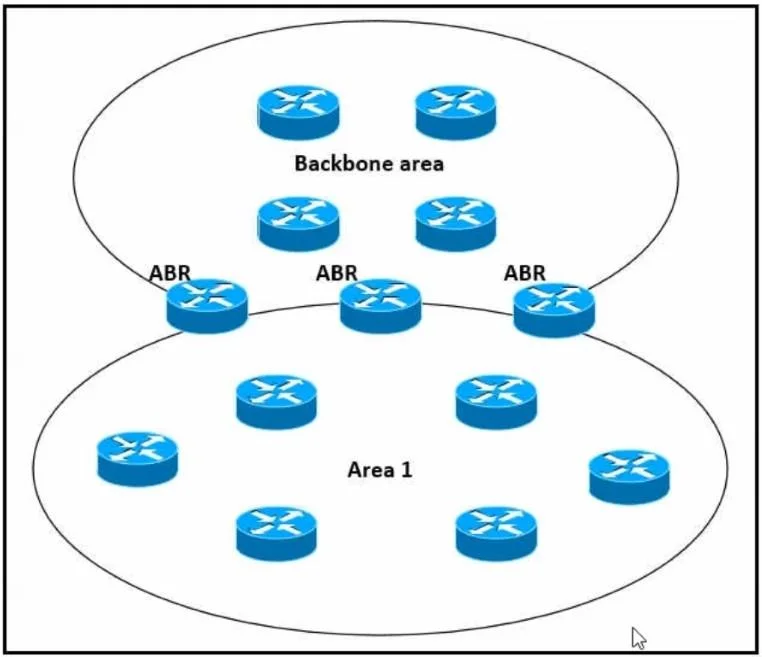
Refer to the exhibit. Which impact of using three or more ABRs between the backbone area and area 1 is true?
The correct answer is A. In a large-scale network LSA replication by all ABRs can cause serious scalability issues. When three or more ABRs connect a non-backbone area to area 0, each ABR independently originates and floods LSAs for all prefixes into the backbone, causing significant LSA replication overhead that becomes a scalability problem in large networks.
Question
Refer to the exhibit. Which impact of using three or more ABRs between the backbone area and area 1 is true?
Exhibit
Options
- AIn a large-scale network LSA replication by all ABRs can cause serious scalability issues
- BMultiple ABRs reduce the CPU processing on each A6R due to splitting prefix advertisement
- CIn a large-scale network multiple ABRs can create microloops.
- DPrefixes from the non-backbone area are advertised by one ABR to the backbone
How the community answered
(25 responses)- A84% (21)
- B4% (1)
- C8% (2)
- D4% (1)
Why each option
When three or more ABRs connect a non-backbone area to area 0, each ABR independently originates and floods LSAs for all prefixes into the backbone, causing significant LSA replication overhead that becomes a scalability problem in large networks.
Each ABR independently generates Type 3 Summary LSAs for all prefixes in the non-backbone area and floods them into area 0. With multiple ABRs, this results in redundant LSA generation and flooding by every ABR, multiplying the size of the LSDB and the frequency of SPF recalculations across all routers in the backbone, which creates serious scalability issues at large scale.
Multiple ABRs do not split prefix advertisement - each ABR independently advertises all prefixes, which increases rather than reduces per-ABR CPU processing.
Microloops are a convergence timing problem caused by unequal update propagation speeds, not a structural consequence of having multiple ABRs between areas.
With multiple ABRs present, all ABRs advertise prefixes from the non-backbone area into the backbone, not just a single ABR.
Concept tested: OSPF ABR scalability and LSA replication behavior
Source: https://www.cisco.com/c/en/us/support/docs/ip/open-shortest-path-first-ospf/7039-1.html
Topics
Community Discussion
No community discussion yet for this question.