nerdexam
Cisco

352-011 · Question #99

Refer to the exhibit. Transit traffic in this large enterprise campus network passes the eBGP core. Per security policy, traffic coming from AS 65444 destined for AS 65466 and vice-versa must pass…

The correct answer is C. Apply next-hop self on both BGP neighbors on AS 65400. Option C is correct because in a broadcast (multi-access) network, when AS 65400 advertises routes learned from AS 65466 to AS 65444, the BGP next-hop attribute still points directly to AS 65466's IP address (all routers share the same subnet). This allows AS 65444 to bypass AS…

Enterprise Network Design

Question

Refer to the exhibit. Transit traffic in this large enterprise campus network passes the eBGP core. Per security policy, traffic coming from AS 65444 destined for AS 65466 and vice-versa must pass through AS 65400. An audit discovers that traffic between 65444 and 65466 did not pass through 65400, instead it is communicating directly. How must you design BGP to ensure that the traffic from AS 65444 destined for AS 65466 passes through AS65400 on this broadcast network?

Exhibit
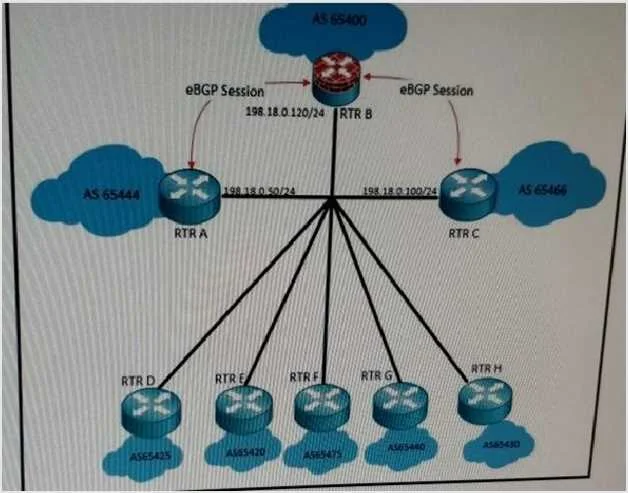
352-011 question #99 exhibit

Options

  • AApply an ACL on AS 65466 to drop the direct traffic between AS 65444 and AS 65466
  • BApply AS-path prepending on AS 65466 and AS 65444
  • CApply next-hop self on both BGP neighbors on AS 65400
  • DApply the MED attribute on the BGP session for AS 65444

How the community answered

(38 responses)
  • A
    11% (4)
  • B
    8% (3)
  • C
    79% (30)
  • D
    3% (1)

Explanation

Option C is correct because in a broadcast (multi-access) network, when AS 65400 advertises routes learned from AS 65466 to AS 65444, the BGP next-hop attribute still points directly to AS 65466's IP address (all routers share the same subnet). This allows AS 65444 to bypass AS 65400 entirely. Applying next-hop-self on AS 65400 forces it to rewrite the next-hop to its own IP before advertising to each neighbor, ensuring all transit traffic physically flows through AS 65400.

Why the distractors fail:

  • A (ACL): Drops traffic entirely rather than rerouting it - this breaks connectivity, not fixes it.
  • B (AS-path prepending): Makes a path appear longer/less preferred, but on a broadcast network the direct path still has the correct reachable next-hop, so prepending alone won't force traffic through AS 65400.
  • D (MED): MED influences inbound path selection into your own AS from a directly connected neighbor - it has no effect on next-hop reachability across a shared broadcast segment.

Memory tip: Think "next-hop-self = traffic through ME." Whenever a transit AS sits on a shared broadcast segment and needs to stay in the forwarding path, next-hop-self is the mechanism - it replaces the originator's IP with the transit AS's own IP, making itself the mandatory waypoint.

Topics

#next-hop self#eBGP path control#BGP policy#path enforcement

Community Discussion

No community discussion yet for this question.

Full 352-011 Practice