
352-001 · Question #662
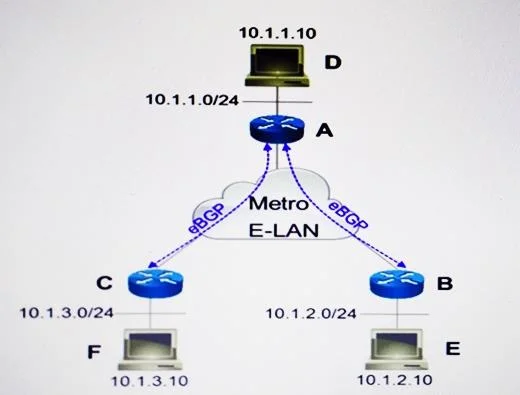
Refer to the exhibit. Company A migrated from Frame Relay WAN to Metro-Ethernet E-LAN service. Router B and C have only eBGP neighbor adjacency with router A using their Metro- Ethernet IP…
The correct answer is A. Packet goes from router B to A and C. With eBGP peerings only between B-A and C-A, Router A replaces the BGP next-hop with its own address when re-advertising routes, so traffic from Host E transits Router A before reaching Router C and Host F.
Question
Refer to the exhibit. Company A migrated from Frame Relay WAN to Metro-Ethernet E-LAN service. Router B and C have only eBGP neighbor adjacency with router A using their Metro- Ethernet IP addresses. What happens when host E sends a packet to host F?
Exhibit
Options
- APacket goes from router B to A and C.
- BPacket is dropped by router B.
- CPacket goes from router B to C.
- DPacket goes from router B to Aand is dropped by router A due to the split-horizon rule.
How the community answered
(70 responses)- A71% (50)
- B4% (3)
- C7% (5)
- D17% (12)
Why each option
With eBGP peerings only between B-A and C-A, Router A replaces the BGP next-hop with its own address when re-advertising routes, so traffic from Host E transits Router A before reaching Router C and Host F.
Standard eBGP behavior requires the advertising router to set itself as the BGP next-hop when re-advertising a route to an eBGP peer. Router A receives the prefix for Host F from Router C with next-hop equal to C, then re-advertises to Router B with next-hop equal to A's own Metro-Ethernet interface. Router B therefore forwards the packet to Router A, which in turn forwards it to Router C en route to Host F.
Router B has a valid BGP route to Host F's network learned from Router A via eBGP, so it has a reachable next-hop and will forward the packet rather than drop it.
Router B's BGP next-hop for Host F points to Router A, not Router C, because Router A replaced the next-hop with its own address during eBGP re-advertisement; direct B-to-C forwarding would only occur if next-hop-unchanged or next-hop-self pointing to C were explicitly configured.
BGP split-horizon is an iBGP restriction that prevents a route learned from one iBGP peer from being re-advertised to another iBGP peer; it does not apply to eBGP sessions, so Router A can freely re-advertise between Router B and Router C.
Concept tested: eBGP next-hop update behavior in shared Ethernet topology
Source: https://www.cisco.com/c/en/us/support/docs/ip/border-gateway-protocol-bgp/13753-25.html
Topics
Community Discussion
No community discussion yet for this question.