
352-001 · Question #676
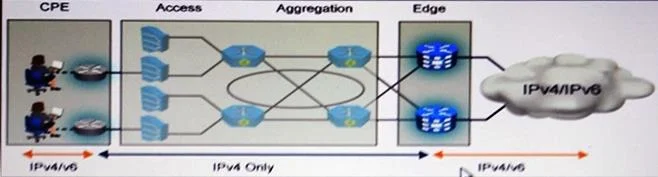
Refer to the exhibit. The service provider ACME wants to offer IPv6 services to their subscribers. However, their access and aggregation devices are IPv4-only and not capable of IPv6 transport…
The correct answer is B. DMVPN D. 6RD. The scenario requires extending IPv6 connectivity from the service provider edge to the CPE across an IPv4-only access/aggregation middle network. Two technologies accomplish this by tunneling IPv6-in-IPv4: 6RD (IPv6 Rapid Deployment) [D]: Designed precisely for this use case…
Question
Refer to the exhibit. The service provider ACME wants to offer IPv6 services to their subscribers. However, their access and aggregation devices are IPv4-only and not capable of IPv6 transport without hardware upgrade. The CPE and edge equipment can be upgraded via software to support IPv6 services. Assume that all the listed technologies are available on the CPE and edge equipment. Which two technologies can be used to extend IPv6 services from edge to CPE? (Choose two.)
Exhibit
Options
- ADS-Lite
- BDMVPN
- CAFT64
- D6RD
- ESLAAC
How the community answered
(31 responses)- A19% (6)
- B65% (20)
- C10% (3)
- E6% (2)
Explanation
The scenario requires extending IPv6 connectivity from the service provider edge to the CPE across an IPv4-only access/aggregation middle network. Two technologies accomplish this by tunneling IPv6-in-IPv4:
-
6RD (IPv6 Rapid Deployment) [D]: Designed precisely for this use case. The CPE encapsulates IPv6 traffic inside IPv4 packets, tunneling it to a 6RD Border Relay at the SP edge. It requires only a software upgrade on CPE and edge equipment and works transparently over IPv4-only access infrastructure.
-
DMVPN (Dynamic Multipoint VPN) [B]: Creates mGRE-based overlay tunnels that can carry IPv6 traffic over an IPv4 underlay. With software upgrades on CPE and edge, DMVPN can extend IPv6 services end-to-end over the IPv4 access network.
The other options are eliminated for these reasons:
- DS-Lite [A]: Tunnels IPv4-in-IPv6 - the opposite direction (used when access is IPv6 but users need IPv4).
- AFT64 [C]: An address family translation/NAT64 mechanism, not a tunneling technology for IPv6-over-IPv4 transport.
- SLAAC [E]: A stateless IPv6 address autoconfiguration protocol, not a transition/tunneling technology.
Topics
Community Discussion
No community discussion yet for this question.