
350-501 · Question #90
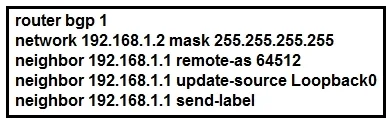
Refer to the exhibit. Which statement about the neighbor statements for 192.168.1.1 is true?
The correct answer is C. The router sends BGP labels for its prefixes to this peer. The neighbor 192.168.1.1 send-label command instructs the router to send BGP labeled IPv4 prefixes to the specified peer, enabling BGP-LU for that neighbor.
Question
Refer to the exhibit. Which statement about the neighbor statements for 192.168.1.1 is true?
Exhibit
Options
- AThe router must have TDP configured for the send-label command to operate
- BThe neighbor router receives at least four labels from this router
- CThe router sends BGP labels for its prefixes to this peer
- DThe router sends only a label for the prefix for LoopbackO.
How the community answered
(18 responses)- A6% (1)
- C89% (16)
- D6% (1)
Why each option
The `neighbor 192.168.1.1 send-label` command instructs the router to send BGP labeled IPv4 prefixes to the specified peer, enabling BGP-LU for that neighbor.
`send-label` is used for BGP Labeled Unicast (BGP-LU) and does not require TDP (Tag Distribution Protocol), which is an older label distribution protocol primarily used with IP routing protocols like RIP or EIGRP.
The command enables sending labels for all BGP IPv4 prefixes advertised to that neighbor, not a specific number of labels like four.
The `neighbor 192.168.1.1 send-label` command enables BGP Labeled Unicast (BGP-LU) for the specified peer, meaning the router will advertise a label for each of its BGP IPv4 prefixes to the neighbor. This allows the BGP next-hop to be resolved via an MPLS LSP rather than an IP route.
The command applies to all BGP IPv4 prefixes that are sent to that peer, not just the prefix for Loopback0.
Concept tested: BGP Labeled Unicast (BGP-LU)
Source: https://www.cisco.com/c/en/us/td/docs/ios-xml/ios/iproute_bgp/configuration/15-mt/irg-15-mt-book/irg-conf-bgp.html
Topics
Community Discussion
No community discussion yet for this question.