
350-501 · Question #89
Refer to the exhibit. Which condition must be met by the OSPF peer of router R1 before the two devices can establish communication?
The correct answer is A. The interface on the OSPF peer must use the same key ID and key value as the configured. OSPF MD5 cryptographic authentication requires that both the key ID and the key value (password) match exactly on both sides of the adjacency. The key ID is used to select which key to use for authentication, and the key value is the shared secret used to generate the MD5 hash…
Question
Refer to the exhibit. Which condition must be met by the OSPF peer of router R1 before the two devices can establish communication?
Exhibit
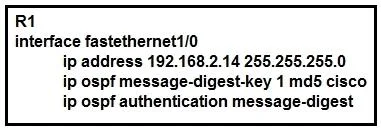
Options
- AThe interface on the OSPF peer must use the same key ID and key value as the configured
- BThe interface on the OSPF peer may have a different key ID, but it must use the same key value
- CThe OSPF peer must be configured as an OSPF stub router
- DThe OSPF peer must use clear-text authentication
How the community answered
(26 responses)- A88% (23)
- C8% (2)
- D4% (1)
Explanation
OSPF MD5 cryptographic authentication requires that both the key ID and the key value (password) match exactly on both sides of the adjacency. The key ID is used to select which key to use for authentication, and the key value is the shared secret used to generate the MD5 hash. If either the key ID or the key value differs between neighbors, OSPF will not form an adjacency. Option B is incorrect - a different key ID will cause authentication failure even with the same key value. Option C (stub router) and Option D (clear-text authentication) are unrelated to the MD5 authentication requirement shown in the exhibit.
Topics
Community Discussion
No community discussion yet for this question.