
350-501 · Question #632
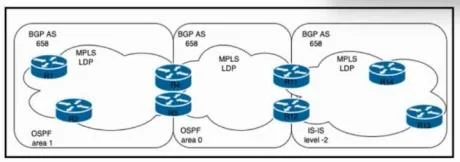
Refer to the exhibit. ISP_A is a Tier-1 ISP that provides private Layer 2 and Layer 3 VPN services across the globe using an MPLS-enabled backbone network. Routers R1, R2, R13, and R14 are PE…
The correct answer is D. Implement Unified MPLS on all MPLS-enabled routers. The engineer needs a scalable MPLS network design based on RFC 3107 to minimize IGP RIB overflow while maintaining QoS capabilities in a large Tier-1 ISP.
Question
Refer to the exhibit. ISP_A is a Tier-1 ISP that provides private Layer 2 and Layer 3 VPN services across the globe using an MPLS-enabled backbone network. Routers R1, R2, R13, and R14 are PE devices. ASRs R3 and R4 and ASBRs R11 and R12 are acting as route reflectors with preconfigured next-hop- self for all BGP neighbors. After the network experienced IGP RIB overflow with multiple routes, a network engineer is working on a more scalable network design to minimize the impact on local RIBs. The solution should be based on RFC 3107 and maintain existing QoS capabilities. Which task must the engineer perform to achieve the goal?
Exhibit
Options
- AImplement Seamless Segment Routing on the ABR routers.
- BImplement MPLS Traffic Engineering on PE routes only.
- CImplement Hierarchical MPLS VPLS across all LDP-enabled routers.
- DImplement Unified MPLS on all MPLS-enabled routers.
How the community answered
(60 responses)- A18% (11)
- B5% (3)
- C12% (7)
- D65% (39)
Why each option
The engineer needs a scalable MPLS network design based on RFC 3107 to minimize IGP RIB overflow while maintaining QoS capabilities in a large Tier-1 ISP.
Seamless Segment Routing is a modern routing paradigm that addresses scalability but is a different technology from the traditional MPLS framework implied by RFC 3107 in this context.
Implementing MPLS Traffic Engineering only on PE routers primarily focuses on optimizing specific traffic paths and resource allocation, not on a holistic approach to minimize IGP RIB overflow across the entire backbone.
Hierarchical MPLS VPLS (H-VPLS) is a specific Layer 2 VPN scaling solution for VPLS services, not a general architecture to mitigate IGP RIB overflow throughout an entire MPLS-enabled backbone.
Unified MPLS is a scalable architecture designed to address challenges in large-scale networks, such as IGP RIB overflow, by segmenting the network into multiple IGP domains. It uses BGP with MPLS Label Unicast (RFC 3107) to exchange reachability information and labels between these domains, allowing the core IGP to maintain fewer routes and effectively reducing the burden on local RIBs while supporting end-to-end QoS.
Concept tested: Unified MPLS for network scalability
Source: https://www.cisco.com/c/en/us/products/collateral/ios-nx-os-software/unified-mpls/solution_overview_c22-729013.html
Topics
Community Discussion
No community discussion yet for this question.