
350-501 · Question #623
Refer to the exhibit. A service provider is running MPLS in the core to support Layer 3 VPN. OSPF is configured to support dynamic routing, and BGP is enabled throughout the network. A network…
The correct answer is B. Establish an LDP neighbor relationship with P1 and P3. To enable a new P router to participate in an MPLS Layer 3 VPN, it must establish Label Distribution Protocol (LDP) neighbor relationships with its directly connected P and PE routers.
Question
Refer to the exhibit. A service provider is running MPLS in the core to support Layer 3 VPN. OSPF is configured to support dynamic routing, and BGP is enabled throughout the network. A network engineer is adding a new P router to the infrastructure and is connecting it to P1 and P3. Which task must the engineer perform on the new router to allow it to participate in the Layer 3 VPN?
Exhibit
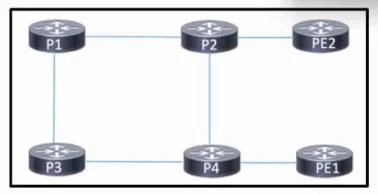
Options
- AEnable LDP sync under the OSPF routing process.
- BEstablish an LDP neighbor relationship with P1 and P3.
- CConfigure OSPF and BGP to support MPLS.
- DEnable LDP and establish an OSPF adjacency in a new area.
How the community answered
(31 responses)- A3% (1)
- B94% (29)
- C3% (1)
Why each option
To enable a new P router to participate in an MPLS Layer 3 VPN, it must establish Label Distribution Protocol (LDP) neighbor relationships with its directly connected P and PE routers.
Enabling LDP sync under OSPF is used to ensure LDP convergence before IGP convergence, preventing blackholes, but it's not the fundamental step for LDP functionality itself.
In an MPLS Layer 3 VPN, P routers are responsible for forwarding labeled packets across the core. This requires them to establish LDP neighbor relationships with adjacent MPLS routers (P and PE routers) to exchange and distribute MPLS labels for the various VPN routes.
While OSPF and BGP are configured in the network, a P router's primary role in L3VPN is MPLS label switching, which is enabled by LDP, not directly by configuring OSPF or BGP to 'support MPLS'.
While LDP needs to be enabled and an OSPF adjacency established, simply enabling LDP and establishing OSPF in a 'new area' doesn't specify the critical step of forming LDP *neighbor relationships* with existing adjacent MPLS routers, which is crucial for label distribution.
Concept tested: MPLS P router configuration in L3VPN
Source: https://www.cisco.com/c/en/us/td/docs/ios-xml/ios/mp_l3_vpns/configuration/xe-16/mp-l3-vpns-xe-16-book/mpls-l3-vpn-overview.html
Topics
Community Discussion
No community discussion yet for this question.