
350-501 · Question #618
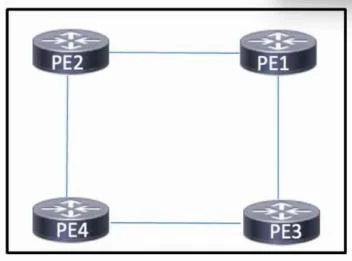
Refer to the exhibit. The four PE routers in the network are connected and running OSPF to share routes. MPLS is enabled on the four routers. The routers are connected and configured to use /30…
The correct answer is B. Configure the devices to establish LDP neighbor relationships to share label information. To implement Layer 3 VPN (L3VPN) support over an MPLS-enabled core, the PE routers must establish LDP neighbor relationships to exchange label information for the VPN routes.
Question
Refer to the exhibit. The four PE routers in the network are connected and running OSPF to share routes. MPLS is enabled on the four routers. The routers are connected and configured to use /30 networks. A network engineer must implement Layer 3 VPN support for traffic between customer sites. Which task must the engineer perform?
Exhibit
Options
- ADeploy IGP in the network to exchange intranet data between the PEs.
- BConfigure the devices to establish LDP neighbor relationships to share label information.
- CImplement MPLS TE tunnels between each router to provide dedicated bandwidth for Layer 3 VPN
- DUpdate the subnet between each router to a /24 prefix.
How the community answered
(44 responses)- A7% (3)
- B89% (39)
- C2% (1)
- D2% (1)
Why each option
To implement Layer 3 VPN (L3VPN) support over an MPLS-enabled core, the PE routers must establish LDP neighbor relationships to exchange label information for the VPN routes.
The question states that OSPF is already running in the network to share routes between PEs, meaning an IGP is already deployed, so this step is redundant and not the missing action for L3VPN support.
For Layer 3 VPN (L3VPN) to function over an MPLS core, Provider Edge (PE) routers need to distribute MPLS labels for the IP prefixes learned via the Interior Gateway Protocol (IGP) as well as for the VPN routes themselves. LDP (Label Distribution Protocol) is the standard protocol used to establish neighbor relationships between LSRs and exchange label mappings for these prefixes, which is a foundational requirement for building the MPLS forwarding plane that supports L3VPNs.
While MPLS Traffic Engineering (TE) tunnels can be used for explicit path control and dedicated bandwidth, they are not a fundamental requirement for basic L3VPN functionality; LDP provides the necessary label distribution for standard L3VPN deployments.
Updating the subnet between each router from /30 to /24 prefixes is unnecessary and wasteful of IP address space for point-to-point links and has no direct impact on enabling Layer 3 VPN support.
Concept tested: MPLS L3VPN - LDP for label distribution
Source: https://www.cisco.com/c/en/us/td/docs/ios_xr_sw/iosxr_6_2_2/mpls/configuration/guide/b-mpls-cg-iosxr-62x-book/b-mpls-cg-iosxr-62x-book_chapter_010.html
Topics
Community Discussion
No community discussion yet for this question.