
350-501 · Question #610
Refer to the exhibit. The company is running IS-IS in its core. A network engineer must segment the network into two areas to isolate departments. However, some networks must be shared from area 2…
The correct answer is D. Implement route-tagging on RB and RD to identify and allow only the routes that should be shared. To share specific networks between IS-IS areas, the engineer must use a mechanism that allows for granular identification and control of routes. Route-tagging is an effective method to mark routes for selective redistribution or filtering between IS-IS areas.
Question
Refer to the exhibit. The company is running IS-IS in its core. A network engineer must segment the network into two areas to isolate departments. However, some networks must be shared from area 2 to area 1, so the engineer has decided to implement route filtering between devices. Which action must the engineer take so that the correct networks are shared between IS-IS areas?
Exhibit
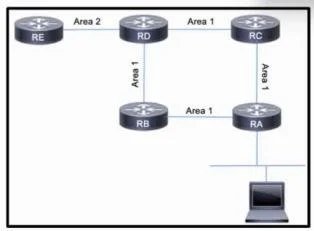
Options
- AApply an ACL on RE to deny unnecessary routes from exiting the interface toward RD.
- BImplement a route map and attach it to a distribute list on RD to filter inbound routes from RE.
- CSet a unique area ID on each router to fully segment the network.
- DImplement route-tagging on RB and RD to identify and allow only the routes that should be shared
How the community answered
(28 responses)- A14% (4)
- B4% (1)
- C4% (1)
- D79% (22)
Why each option
To share specific networks between IS-IS areas, the engineer must use a mechanism that allows for granular identification and control of routes. Route-tagging is an effective method to mark routes for selective redistribution or filtering between IS-IS areas.
Applying an ACL on RE to deny routes is typically used for packet filtering, not for directly controlling route advertisements in a routing protocol like IS-IS for inter-area filtering, and it lacks the specificity of route-tagging for inter-area sharing.
While route maps and distribute lists are used for filtering, implementing them inbound on RD from RE without a preceding mechanism like route-tagging makes it difficult to specifically identify and filter *shared* networks between the different areas based on the scenario's requirement.
Setting a unique area ID on each router would further segment the network but does not address the requirement of *sharing specific networks* between these isolated areas; it would actually increase isolation without a specific sharing mechanism.
Route-tagging allows specific routes to be identified with a unique tag as they are redistributed from one IS-IS area to another, typically at a Level 1-2 router. This tag can then be used in a route-map or distribute-list on a bordering router (like RD, a Level 2 router) to permit or deny their advertisement to other areas (e.g., from Area 2 to Area 1), ensuring only designated networks are shared.
Concept tested: IS-IS route tagging and filtering between areas
Source: https://www.cisco.com/c/en/us/td/docs/ios-xml/ios/iproute_isis/configuration/15-mt/irs-15-mt-book/irs-tagging-routes.html
Topics
Community Discussion
No community discussion yet for this question.